Aftermarket BMW Wheels: The Complete Guide

BMW owners upgrade wheels more than almost any other enthusiast segment, and for good reason. The stock wheels on most BMWs — whether it's an F30 335i, an E92 M3, or a G80 M3 — are compromises. They're heavy, they're conservative relative to what the chassis can handle visually, and on non-M trims they're often cast alloys built to a fleet budget. A good set of aftermarket BMW wheels changes the weight, the look, and how the car actually feels through a corner.
But BMW fitment is one of the more technical exercises in the aftermarket wheel space. Between staggered setups on rear-wheel-drive models, the specific PCD, hub bore requirements, and how aggressively the cars sit once lowered, there's real room to get it wrong. This guide covers everything — sizing, construction, cost, and how to get a set built properly without overpaying.
Why BMW Fitment Is More Complex Than Most
All BMWs use a 5x120 bolt pattern, which is consistent across virtually every model from the 1 Series through the X7 and the M cars. That's the easy part. The complexity comes from three other factors: hub bore, offset sensitivity, and staggered sizing.
BMW uses a 72.6mm hub bore on essentially all passenger models. This matters because most aftermarket wheels are made with a 74.1mm or similar generic bore to fit multiple applications, which means you'll need hub centric rings to eliminate vibration at highway speeds. It's a small detail that a lot of buyers overlook until they're chasing a shimmy at 75 mph.
Offset on BMWs is tighter than people realize. A standard F30 3 Series runs around ET35–ET40 on the rear with 225/45R18 tires. Go to ET25 without adjusting the tire width and you'll have rubbing issues on the inner fender, or you'll need spacers that introduce their own complications. The M cars run even more aggressive factory offsets — the F80 M3 is staggered from the factory at 19x9 ET40 front and 19x10 ET25 rear, so aftermarket sizing needs to match or intentionally deviate for a more aggressive stance.
And then there's the staggered question. Most rear-wheel-drive BMWs — 3 Series, 4 Series, M2, M3, M4, M5 — look and handle better with a staggered setup. Running a wider rear wheel (typically +1 inch) with a lower offset fills the rear quarters properly and allows for a slightly wider contact patch. Square setups work too, but you lose some of the aggressive rear-biased stance that makes these cars look right.
Cast vs. Forged: What It Means on a BMW
Most OEM BMW wheels, even the M Performance options, are cast. That includes the shadowline styling packages and the standard Sport line fitments on cars like the 530i and 430i. Even some M cars ship with cast alloys from the factory. Forged wheels are reserved for M Performance accessories or the top-tier CS/CSL variants, and they cost accordingly from BMW directly.
The difference matters most on driver-focused BMWs. A set of cast 19-inch wheels on an F82 M4 might weigh 25–27 lbs per corner. A comparable forged wheel comes in at 18–21 lbs depending on design. That's 16–24 lbs of unsprung, rotational mass removed from the car — you feel it in steering response, turn-in, and how quickly the car changes direction. On a street car it's incremental; on a car driven at a track day or autocross, it's genuinely meaningful.
Flow-formed wheels sit between the two. The barrel is spun under pressure during manufacturing, which densifies the alloy and allows the wheel to be lighter than a pure cast piece while costing significantly less than a fully forged monoblock. For a street-driven F30 or G20 3 Series, flow-formed is often the right answer — strong, light enough to matter, and substantially cheaper than forged. Understanding the differences in detail is worth reading through our breakdown of cast vs forged wheels before committing.
Sizing Guide by Platform
Getting sizing right means knowing what the car can actually run without modifications versus what requires a fender roll or spacer. Below are practical starting points for the most common platforms.
F30/F31/F80 (3 Series / M3, 2012–2019) The F30 non-M will happily run 18x8.5 ET35 all around on a square setup, or 18x8.5 ET38 front / 18x9.5 ET35 rear for a mild stagger. Step up to 19 inches and you're looking at 19x8.5 ET35 front / 19x9.5 ET30 rear as a comfortable street fitment. The F80 M3 has more clearance and looks proportionally better at 19x10 front / 19x11 rear with aggressive offsets — ET35/ET22 is a popular combo with 265/35 rear rubber.
G20/G21/G80 (3 Series / M3, 2019–present) The G chassis runs very similarly to the F30 but the wheel arches are slightly more pronounced. 19x9 ET40 square is conservative but works perfectly. The G80 M3 is frequently run at 19x10 ET35 front and 20x11 ET25 rear for a flusher look, though this requires careful tire selection on the rear to avoid contact under compression.
F82/F83/G82 (M4) Any M4 looks correct at 20 inches. The F82 M4 runs 20x9 ET35 front and 20x10.5 ET25 rear as a near-perfect street fitment. The G82 M4 with its wider body can push to 20x10 front / 20x11.5 rear without body modification on most builds.
F10/G30 (5 Series) The 5 Series is often run square — 19x9 ET40 fits cleanly on the F10 without drama. The G30 M550i is frequently done at 20x9 ET38 all around, which fills the larger arches on that body style adequately.
F32/G22 (4 Series Coupe) Virtually the same fitment parameters as the 3 Series it shares a platform with. 19x8.5 ET38 front / 19x9.5 ET32 rear is a proven street setup on lowered F32s.
What to Expect from Staggered Setups
If you're running a rear-wheel-drive BMW and you want it to look correct, a staggered fitment is worth understanding thoroughly. The short version: a wider rear wheel pushes the tire outward to fill the rear arch, which on cars like the M3 and M4 creates that planted, purposeful stance that square setups can't quite replicate. The tradeoff is that you can't rotate tires, which matters if you track the car hard. For street use, the rear tires typically outlast the fronts on a RWD car anyway, so this is usually a non-issue.
The staggered wheels meaning and how it applies to different BMW models is a full topic on its own — worth reading before you finalize sizing.
Design Choices That Work on BMWs
BMW body lines are characterized by tight shoulders, prominent wheel arches, and a generally taut, athletic proportion. Certain wheel designs reinforce that language better than others.
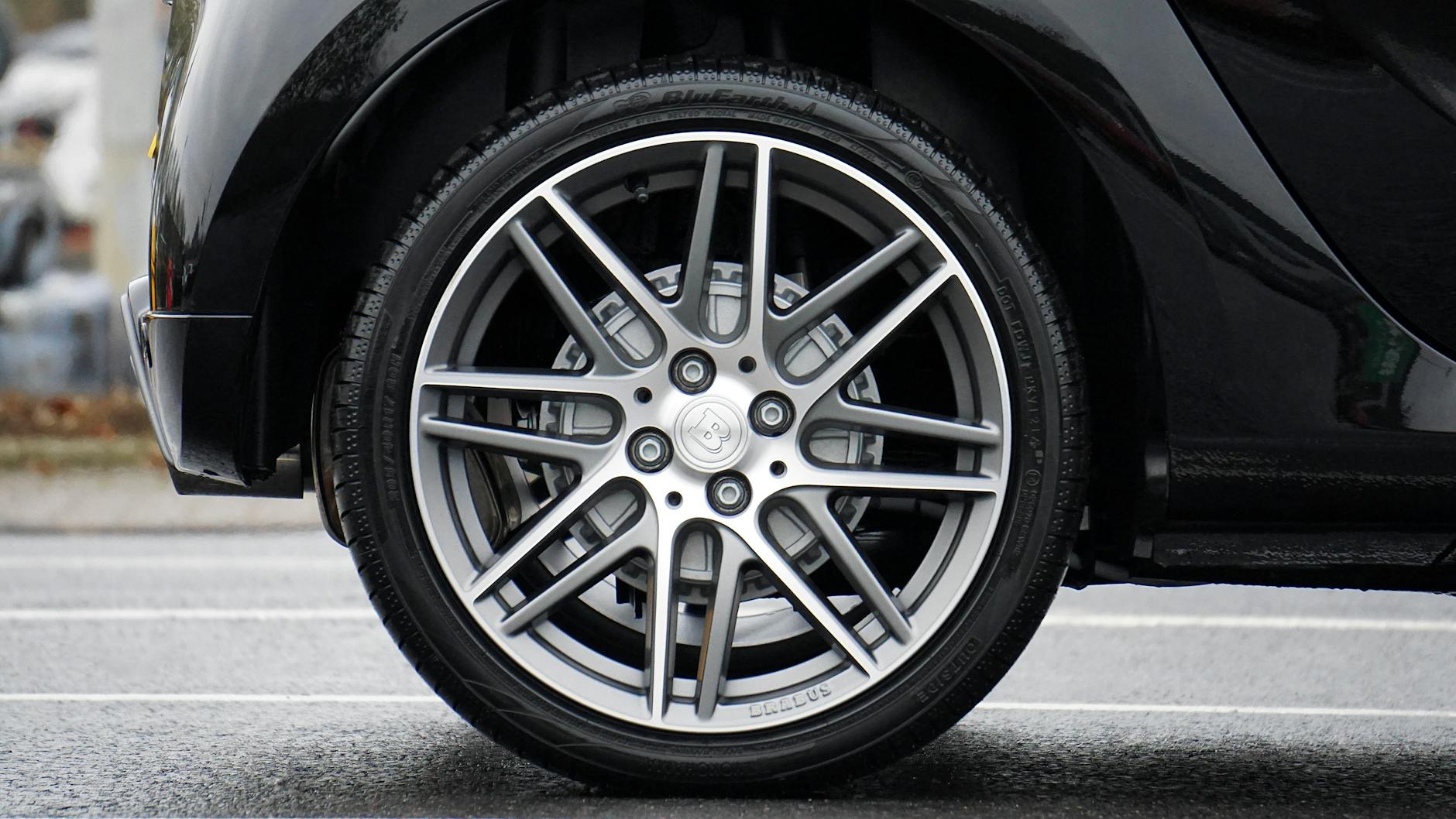
Multi-spoke designs — anything from 10 to 20 spokes — work well because they echo the mechanical complexity the cars project. The OEM M Performance wheels use multi-spoke designs for exactly this reason. Y-spoke and turbine-style designs also work, giving a more aggressive visual weight to the barrel.
Concave faces look particularly good on BMWs because the deep dish creates shadow and visual depth against the car's arches. A 19x10 or 20x11 wheel with a moderately concave face and an aggressive offset fills the arch and creates the kind of dimensional look that flat-faced wheels can't. Our guide to concave wheels covers how to spec them correctly.
Finish choices depend on the color of the car. Hyper silver or machine-faced wheels look period-correct on Mineral White, Alpine White, or Black Sapphire — they're the palette BMW's own designers use. Matte black or gloss anthracite on a dark car creates a blacked-out, monochromatic look that works on Sport Line and M Sport spec cars. Brushed titanium is a newer option that photographs exceptionally well on Portimao Blue or Isle of Man Green.
Avoid full chrome on a BMW. The car's design language reads as precision engineering, and chrome reads as garish against it. Polished lips with brushed or painted faces are fine — that's a different aesthetic entirely — but full chrome doesn't suit these platforms.
The Cost Reality: OEM, Legacy Brands, and Direct-to-Consumer
BMW M Performance wheels for an F82 M4 run $600–$900 per wheel from BMW. Brands like BBS, Vossen, or HRE at comparable sizing and construction come in at $500–$1,200 per corner for their forged lines. A set of four forged 20-inch wheels for an M4 from those brands typically runs $4,000–$6,000 before tires and mounting.
Custom forged wheels built through a direct-to-consumer manufacturer using the same OEM forging processes — the same 6061-T6 aluminum billet, the same CNC finishing — can come in at $1,800–$3,000 for a set of four at comparable specs. That's a 50–70% reduction driven by eliminating dealer markup, distributor margin, and legacy brand overhead, not by compromising the forging process or alloy quality. Understanding the full landscape of forged wheels brands helps calibrate what you're actually paying for.
Flow-formed options are even more accessible — $1,200–$2,000 for a set of four at 18–19 inches is realistic, and for a street-driven 3 Series or 4 Series that never sees a track, the performance delta versus fully forged is negligible.
Hub Centric Rings, TPMS, and Practical Fitment Details
A few specifics worth knowing before you order:
Hub centric rings: If the wheel center bore is larger than BMW's 72.6mm, you'll need rings to fill the gap. Always specify 72.6mm when ordering or confirm rings are included. Running without them usually results in vibration that gets worse as speed increases and is frequently misdiagnosed as a wheel balance issue.
TPMS: All modern BMWs have tire pressure monitoring systems. Some aftermarket wheels accommodate the factory TPMS sensors, but you need to verify the valve stem hole size and placement matches your sensors. If not, replacement TPMS sensors that work with the BMW system are available — budget roughly $60–$100 per sensor and plan to have the system re-initialized after installation.
Lug bolts, not lug nuts: BMWs use lug bolts that thread into the hub, not lug nuts that thread onto a stud. This affects aftermarket wheel compatibility — specifically the seat type. BMW uses a spherical or ball seat, so your lug bolts need to match the seat on the aftermarket wheel. Most reputable aftermarket wheels specify the correct seat type; verify before you order.
Center caps: The OEM BMW roundel center cap won't fit most aftermarket wheels unless the center bore is designed for it. Some manufacturers offer BMW-fitment center caps; others use their own branding. If having the roundel matters, confirm compatibility at time of order.
Getting Custom BMW Wheels Built to Spec
For BMW owners who want something beyond what's in a catalog — a specific spoke count, a design that references a motorsport livery, an unusual finish, or a sizing combination that doesn't exist off the shelf — custom forged BMW wheels are more accessible than they used to be.
The process at ForgedToFit works like this: you choose a design from the catalog or upload your own concept, we produce a 3D CAD rendering for approval, then manufacture and ship direct. Fitment specs for your specific chassis are built into the order from the start — bolt pattern, hub bore, offset, and width are all confirmed before manufacturing begins. Lead time is typically 6–8 weeks, which is the normal timeline for forged production.
For anyone researching the full custom process before ordering, our deep dive on custom forged wheels for BMW covers design options and what to expect in detail.
Common Mistakes BMW Owners Make When Buying Aftermarket Wheels
A few patterns show up repeatedly when things go wrong:
Buying wheels with the wrong offset for a lowered car. If the car is already on coilovers or springs, the wheel geometry changes. An offset that's borderline safe at stock ride height will rub after lowering. Account for where the car will actually sit, not where it sits in the showroom.
Going too large on diameter. 20-inch wheels look dramatic but 19-inch wheels are often the better choice for street use — more sidewall means better ride quality, more tire choices, and lower replacement cost. M cars can justify 20s, but a 330i or 430i doesn't need them.
Choosing the cheapest cast option without understanding the weight penalty. Cast wheels at the heavy end — some budget options run 28–32 lbs at 19 inches — actually make the car feel worse than stock. If cost is the primary concern, a light flow-formed wheel at a modest diameter beats a heavy cast wheel at a large one every time. Our breakdown of cheap aftermarket wheels explains the tradeoffs directly.
Ignoring the visual scale. A 19x8.5 ET45 wheel with a very positive offset sits deep in the arch and looks tucked — fine for a clean daily driver, looks underdone on a modified car. Matching the wheel's visual mass to the body modifications on the car requires intentional fitment decisions, not just buying whatever a forum thread recommends.
Frequently asked questions
What bolt pattern do BMW wheels use?
All BMW passenger cars — 1 Series through 8 Series, M cars, and most X models — use a 5x120mm bolt pattern. This is consistent across essentially the entire modern BMW lineup, which makes cross-platform fitment straightforward as long as offset and hub bore are also matched correctly.
What hub bore do BMW aftermarket wheels need?
BMW uses a 72.6mm hub bore. Most aftermarket wheels are produced with a larger generic bore (commonly 74.1mm) to fit multiple makes. If your wheel has a larger bore than 72.6mm, you'll need hub centric rings to fill the gap — skipping them typically causes vibration at highway speeds that's hard to balance out.
Should I run staggered or square wheels on my BMW?
For rear-wheel-drive BMWs — 3 Series, 4 Series, M2, M3, M4, M5 — staggered fitment (wider rear wheel) looks more proportional and is closer to how the M cars are spec'd from the factory. Square setups work and allow tire rotation, which matters if you track the car. For street use on a non-M model, either works; for M cars and lowered sport builds, staggered is usually the better choice visually and dynamically.
Are forged wheels worth it on a street BMW?
On a daily driver that never sees a track, the performance gains from forged over quality flow-formed are subtle. Where forged makes a clear difference is on cars driven hard — track days, spirited mountain roads — where reduced unsprung weight improves turn-in and steering feedback noticeably. If budget is a constraint, a light flow-formed wheel at 19–20 lbs beats a heavy forged wheel at 24 lbs, so construction quality matters more than the forging label alone.
What size wheels fit an F30 335i?
The F30 335i runs well at 18x8.5 ET35 square for a clean, practical setup, or 19x8.5 ET38 front / 19x9.5 ET32 rear for a mild stagger. If the car is lowered, reduce rear offset slightly (ET28–ET30) to avoid inner liner contact. Going wider than 9.5 inches on the rear at 19 inches typically requires a fender roll unless you're running a very conservative offset.
How much do custom forged BMW wheels cost compared to brands like BBS or HRE?
BBS and HRE forged wheels typically run $500–$1,200 per wheel at 19–20 inch sizing for their forged lines, putting a set of four at $4,000–$6,000 before tires. Custom forged wheels made through a direct-to-consumer manufacturer using the same forging process and alloy quality can come in at $1,800–$3,000 for a set — roughly 50–70% less. The price difference is driven by eliminating brand markup and distributor margins, not by compromising on the actual forging or alloy spec.