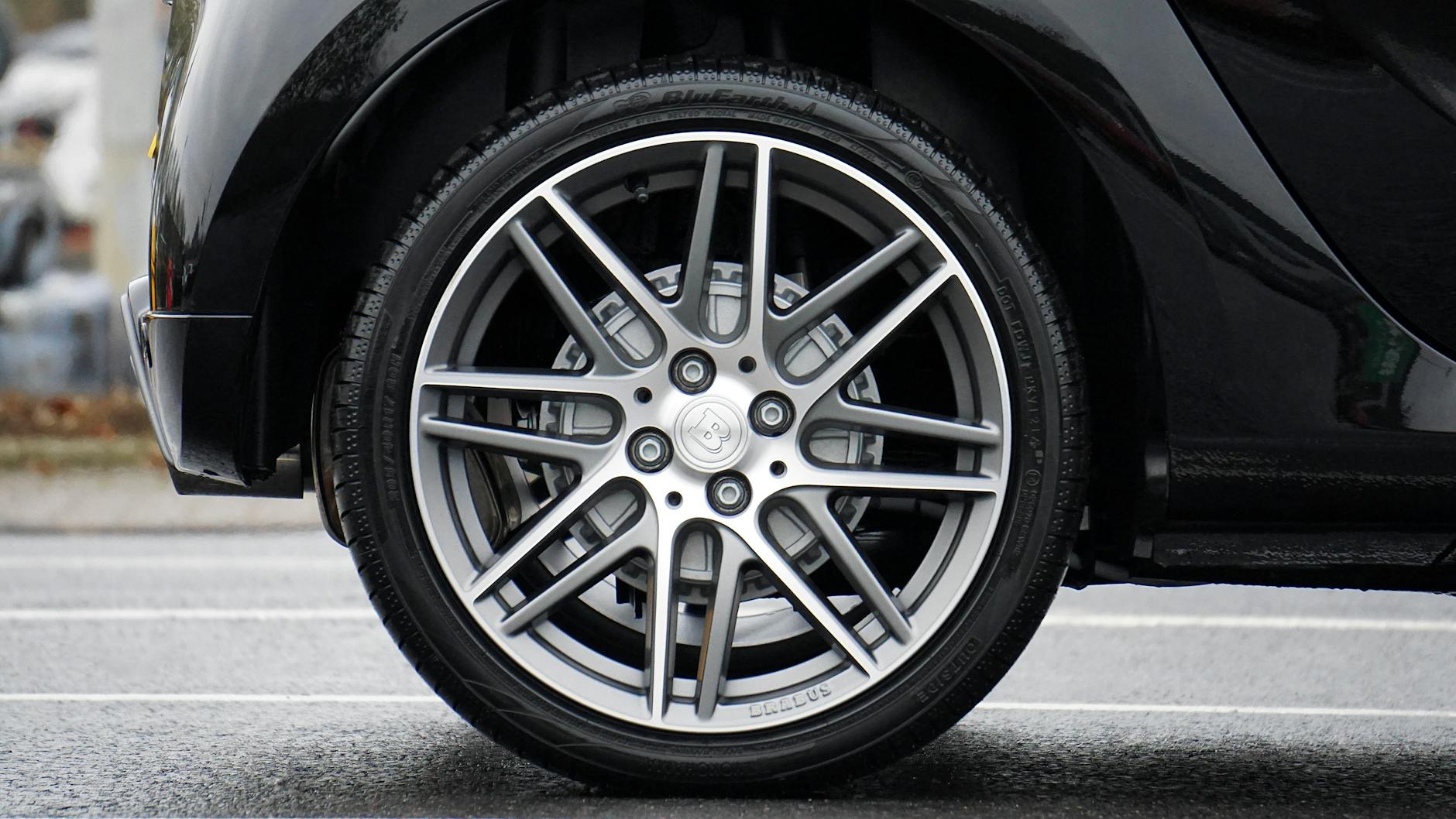
Concave Wheels: What They Are and How to Get Them Right

Concave wheels are, by a significant margin, the most requested aesthetic direction in custom wheel builds. The inward sweep of the face toward the barrel creates a sense of depth that flat or convex profiles simply can't replicate — and when the fitment is dialed in, the wheel looks like it was carved specifically for that car. When it's wrong, it looks like you just bolted on whatever was on sale. Getting it right requires understanding what actually creates that concave look, how much of it is face geometry versus offset, and what your specific platform can handle.
What Makes a Wheel "Concave"
The term gets used loosely, so let's be precise. A concave wheel has spokes or a face that slopes inward — from the outer lip toward the center hub — creating a dish-like or bowl-shaped profile when viewed from the front. The spokes sit deeper in the barrel than the outer rim flange. That's the defining characteristic.
The degree of concavity is where the language gets murky. The industry generally breaks it into three tiers:
- Mild concave — a subtle inward angle, barely noticeable in photos but clean in person
- Medium concave — the sweet spot for most builds; clearly visible depth without being dramatic
- Deep/ultra concave — aggressive dish, often paired with wide-body fitment or substantial lip, where the spokes recede well behind the outer flange
The depth isn't purely cosmetic. It's a direct function of how the wheel is dimensioned — specifically the relationship between overall width, the position of the spoke attachment point, and how much barrel depth exists in front of and behind that point.
To understand this more concretely: a 20x10" wheel at ET20 has roughly 80mm of barrel depth from the outer lip to the mounting face. A 20x8.5" at ET45 has perhaps 30mm. The first wheel has the raw geometry to support deep concavity; the second does not, regardless of how aggressively the spokes are angled. The face design is working with what the barrel gives it.
Face Profile vs. Offset: Two Different Variables
This is where a lot of buyers get confused. Face profile and offset both contribute to how a wheel looks on the car, but they're independent variables.
Face profile is how the spokes are shaped — their angle relative to the outer rim plane. Two wheels with identical dimensions can look completely different if one has flat spokes and the other has an aggressive inward sweep.
Offset is the distance between the wheel's mounting face and its centerline, measured in millimeters. A lower offset (more negative) pushes the wheel outward in the fender. A higher offset (more positive) tucks it inward. On a wide, staggered fitment with aggressive negative offset, even a mildly concave face can look dramatically deep because the outer lip protrudes substantially in front of the spoke.
For platforms like an F30 335i or a Mustang GT, this distinction matters enormously. The F30 runs relatively tight clearances, so you're working with offset more carefully — typically ET20–ET35 on a 9" rear with a 225/40 tire on OEM arches. You can still run a medium-concave face at those specs and get a great look. The Mustang GT has far more flexibility in the rear, where a 10.5" wide wheel at ET25 with a pronounced concave face on the rear quarter looks absolutely correct for the platform.
A useful way to think about the interaction: offset determines how much of the barrel is visible from outside the car, while face profile determines how dramatically the spokes use that visible barrel. Get offset wrong — say, ET45 on a platform that could handle ET20 — and you've wasted the face geometry. The outer lip disappears under the fender and the depth reads as nothing. Nail the offset, and even a medium-concave face becomes a serious visual statement.
Why Concave Wheels Look Best on Specific Fitments
Concave faces are most visually effective when there's actual barrel depth visible from outside the car. That requires two things: adequate width and appropriate offset.
On a narrow wheel — say, 7.5" wide at ET45 tucked deep under an uninspired fender — even the most aggressive face profile won't read as concave from five feet away. The outer lip barely exists. All that sculpted geometry is hidden in the wheel well.
Conversely, take a Model 3 running 20x9.5" wheels at ET30 all around with a slight poke or flush stance, and a deep-concave 10-spoke face becomes the centerpiece of the car's appearance. The barrel depth is visible, the outer lip frames the spoke recession, and the whole thing reads correctly.
Staggered setups amplify this further. Running a square setup (same width front and rear) with concave faces works well, but stepping up to a staggered fitment — 9" front, 10.5" rear — gives you a wider rear barrel to work with, letting you run a more aggressive concave profile in back without compromising front handling geometry. For rear-wheel-drive platforms that support staggered fitment, this is worth considering seriously.
The E90/E92 M3 is a textbook example. Factory stagger runs 18x8.5" front and 18x9.5" rear. Most aftermarket upgrades go to 19x9" front and 19x10.5" rear, sometimes 19x11" at the rear with appropriate clearance work. At those dimensions, a deep-concave face on the rear — even a modest one by forged standards — fills the rear arch with presence. The front uses a less aggressive concave to preserve steering clearance and keep the visual weight balanced front-to-rear.
Wide-body fitments change the calculus entirely. When fender flares add 30–50mm of coverage per side, the available offset range widens dramatically. A Liberty Walk or Rocket Bunny-style build on a 370Z or Supra can support wheels in the 10.5–11.5" range at very low offsets (ET0 to ET15), creating the kind of lip depth where ultra-concave faces find their natural home. The spokes can recess 40–50mm behind the outer flange and still look proportional because the flare gives the lip somewhere to be.
Spoke Count, Design, and How They Interact With Concavity
Not all spoke designs translate equally to concave profiles. This is underappreciated.
Split spokes and Y-spokes tend to show concavity most dramatically. The angular branching of spokes radiating from the hub makes the depth recession visually obvious — your eye follows the angle of the spoke into the barrel. Designs like a classic 10-spoke split or a Y-spoke 6-spoke layout cast strong directional shadow lines that communicate depth even in flat lighting.
Mesh and multi-spoke designs (think 10–20 spokes) work well with mild-to-medium concavity. The dense spoke pattern creates visual mass that benefits from a pronounced face angle, but ultra-deep concavity can make the design look cluttered rather than deep. HRE's P200 series and BBS CI-R are examples where moderate concavity works in concert with a multi-spoke layout — the face has presence without overwhelming the design.
Monoblock designs with thick, sculpted spokes — like a 5-spoke or 6-spoke layout — are excellent candidates for aggressive concavity. The large spoke surfaces amplify the directional shadow lines that make depth apparent in photos and in person. A 5-spoke with wide, tapering spokes at aggressive concavity reads almost architectural — the spokes become structural elements you look at rather than through.
Turbine/aero-style designs with enclosed or partial-mesh faces are typically limited to mild concavity by their geometry. The face plates constrain how far the spokes can recess before structural or aerodynamic clearances become a problem. These designs tend to prioritize visual rotation and flow over depth, so the concave effect is secondary.
Directional designs — asymmetric spoke patterns that create a visual sense of rotation — get an additional benefit from concavity. The depth adds a second visual axis to the wheel's appearance, so it reads differently from different viewing angles. A directional 9-spoke at medium concavity can look flat when facing straight-on but dramatic from a three-quarter view. For cars photographed frequently or shown at events, that dynamism is worth considering.
Forged vs. Cast for Concave Profiles
This matters more than most buyers realize. Casting concave profiles — particularly deep ones — introduces structural concerns at the thinner sections of the spoke, where the face angles sharply inward. Cast aluminum has lower tensile strength than forged, so manufacturers either add material (adding weight) or accept compromised safety margins to achieve the visual effect.
Forged wheels solve this cleanly. The forging process aligns the grain structure of the aluminum to follow the shape of the part, which means a deeply concave forged spoke can be machined thinner than a cast equivalent while maintaining superior strength. That's why deep-concave fitments on performance cars — track-day builds, sport sedans — are almost exclusively forged. The weight savings compound: you're not adding material to compensate for casting's structural limits.
To put real numbers on it: a cast 20x10" wheel in a deep-concave configuration might weigh 26–30 lbs per corner. A forged equivalent designed to the same dimensions and similar spoke geometry typically comes in at 18–22 lbs. Multiply that across four corners and you're looking at 16–32 lbs of unsprung mass reduction — a difference that's measurable in steering feel, ride compliance, and acceleration response, not just on a scale.
Flow-formed wheels occupy middle ground. The barrel is rolled under heat and pressure, improving the rim section considerably, but the face is still cast. For mild-to-medium concave profiles with a reasonable budget, flow-formed is a solid compromise. For truly aggressive deep concave profiles, full forged is the right answer.
One practical marker: if a cast or flow-formed wheel is advertising ultra-deep concavity at a very low price, scrutinize the load rating. JWL and VIA ratings are a baseline, but they don't test the specific failure modes that aggressive concave profiles introduce at the spoke-to-barrel junction. A reputable manufacturer can show you fatigue testing data for the specific design, not just a generic certification for the brand.
Getting the Fitment Right: Real Numbers
The theory is straightforward; the execution requires specifics. Here are the parameters you need to nail before ordering any concave wheel:
Diameter and width — Diameter is usually driven by brake clearance (minimum) and fender arch (maximum). Width is constrained by track width, suspension geometry, and what the tire you want to run actually mounts to safely. A 275/35R20 tire mounts optimally on a 9.5–10.5" wide rim. Don't run a 275 on a 9" if you want the sidewall to sit correctly.
Offset (ET) — Get this from your hub-to-fender measurement, not from a forum post about what someone else runs. Two F80 M3s can run different offsets depending on whether one has OEM arches and one has a wide body. Your car, your measurement.
Hub bore — This is non-negotiable. A wheel with the wrong hub bore running on a hub ring is fine for road use; on a track, it's a liability. Custom-drilled hub bore to match your specific hub is the right approach.
PCD (bolt pattern) — Self-explanatory, but double-check against your actual hub, not assumed specs. Some platforms changed bolt patterns mid-generation. The 5x114.3 to 5x120 shift between Nissan and BMW applications catches people regularly when building wheels that might be resold or swapped.
Backspace — Related to offset but expressed differently (distance from the back of the wheel to the mounting face). Useful for checking caliper and inner arch clearance when offset alone doesn't tell the whole story. On cars with large-diameter rotors and aggressive calipers — a Brembo GT or AP Racing setup — backspace gives you a more direct number to work with than offset when checking inner clearance.
With those five parameters locked in, you can choose face concavity as an aesthetic decision rather than a structural one. That's the right sequence: fitment first, aesthetics second. Buyers who reverse that order — falling in love with a specific wheel design and then trying to make the numbers work — end up compromising on one or the other.
Concave Wheels and Brake Clearance
Deep concave profiles push the spokes away from the brake caliper, which is actually advantageous for clearance on performance cars with large caliper setups. A deeply recessed spoke is less likely to contact an aftermarket big brake kit than a flat-face wheel of the same diameter. That's one practical benefit of the design beyond aesthetics.
This is particularly relevant on platforms where big brake upgrades have become common — C7 Corvettes, Porsche 991s, BMW M cars — where the caliper body extends substantially outward from the hub. A flat-face wheel at 19" diameter on a 991 with front Brembo calipers requires careful clearance checks; a deep-concave design of the same diameter often clears with margin to spare because the spokes are simply not in the caliper's path.
The caveat is center bore and hub-face fitment. A deeply concave wheel still needs adequate material at the hub mounting face for the lug nuts or bolts to clamp against properly. Reputable manufacturers — and any proper custom forging operation — design for this. Budget cast wheels sometimes sacrifice hub-face thickness to chase the concave look, which creates clamp load problems. Don't buy wheels from a brand that can't show you structural analysis or load rating data.
Custom Concave Wheels: What the Build Process Looks Like
If you want a specific depth, spoke design, or dimension that off-the-shelf manufacturers don't offer, custom forging is the path. The process at ForgedToFit follows a straightforward sequence: you submit your fitment specs and design direction (or upload your own design), we generate a 3D CAD model for your approval, and then it goes to our OEM forging partner — 15 years of forging experience, the same facility that supplies tier-one automotive programs — for manufacture.
The CAD approval stage is where concavity gets dialed in precisely. You're not choosing from a catalog of fixed concave depths — you're specifying the exact spoke recession relative to the outer lip, the spoke taper, the face angle, and the barrel profile. If you want 35mm of visible spoke recession at the inner spoke edge and a sharp shadow line at the junction with the barrel, that's what gets modeled and what gets made.
The practical advantage of this over buying catalog concave wheels from a legacy brand is twofold. First, the wheel is dimensioned exactly for your car, not adapted from a catalog SKU that approximates your fitment. Second, the pricing reflects direct manufacturing — no distributor margin, no brand premium — which typically puts custom forged concave wheels at 50–70% less than comparable pieces from established luxury wheel brands.
For a platform like a Porsche 911 (991 or 992 generation) where OEM-supplier prices for a set of 20" forged concave wheels can exceed $5,000–$8,000, that delta is substantial. Custom forged concave sets for the same application at comparable material and construction quality typically land in the $1,800–$2,800 range for a full four-corner set, depending on width and finish complexity.
Finish Options and How They Affect the Look of Concavity
Finish choice amplifies or mutes the visual impact of a concave profile. High-polish or mirror-machined faces create sharp contrast between the recessed spokes and the protruding outer lip — maximum visual drama. If you want the depth to be the centerpiece of the wheel's appearance, a two-tone approach (polished face, brushed or matte barrel) works extremely well.
Matte or satin monocolor finishes are subtler. The lack of reflective contrast softens the apparent depth, which can work beautifully on a restrained build or a dark-colored car where you don't want the wheels competing with the body. Gloss black with a machined face is a perennial choice that photographs well and shows depth without being loud.
Powder coat in a single color tends to flatten the concave effect somewhat — the uniform surface texture reduces the shadow play that makes concavity visible. If you're going single-color powder, choose a shade with some sheen, or consider a contrasting machined lip to give the eye something to reference the depth against.
For builds where the finish needs to hold up under track or autocross use, bare machined aluminum faces require more maintenance than powder or painted finishes — brake dust etches polished aluminum quickly and requires regular cleaning. A brushed or satin machined finish is more forgiving in that context while still showing concavity clearly.
Liquid paint (applied by a qualified automotive painter rather than powder coated) bridges the gap between the durability of powder and the finish quality of machining. Two-stage liquid paint in a metallic or pearl formula, clearcoated over the concave face, retains some of the reflective quality that makes depth readable while being more durable than bare metal. It's an underused option for buyers who want visual depth without committing to high-maintenance polished finishes.
For reference on how concave profiles compare structurally and visually to flat-face designs, the dedicated breakdown in Concave vs Flat Face Wheels Explained covers that comparison in detail. And if you're working through broader fitment decisions for a custom build, custom offset wheels are worth reviewing before you finalize dimensions.
The same forging process that enables deep concave profiles also applies to other aggressive dimensional builds — deep dish wheels are a related category worth understanding if you're considering wide-lip fitments alongside your concave face choice.
If you're still deciding between construction methods, the flow formed vs forged wheels comparison is the most direct reference for where each process makes sense given budget and use case.
Frequently asked questions
What's the difference between a concave wheel and a deep dish wheel?
A concave wheel refers to the face profile — spokes that slope inward from the outer rim toward the hub. A deep dish wheel refers to the barrel depth and visible outer lip. You can have a deep-dish wheel with a flat face, or a concave wheel with a modest lip. They often appear together on aggressive fitments, but they're separate design characteristics.
Do concave wheels affect structural strength?
On forged wheels, no — the grain structure follows the spoke geometry, so a concave profile doesn't compromise strength. On cast wheels, aggressive concavity can thin the spoke cross-section at the face angle, which is why reputable cast manufacturers add material there. Always check load ratings regardless of construction method.
What offset should I run for the most aggressive concave look?
Lower (more negative) offset pushes the wheel outward, increasing visible barrel depth and making the concave face appear more pronounced. But offset is constrained by your car's track width, fender clearance, and suspension geometry — pushing past those limits causes rubbing or handling issues. Get your hub-to-fender measurement first, then choose the most aggressive offset that fits within those constraints.
Can I run concave wheels on a front-wheel-drive car?
Yes. FWD cars are more limited in how aggressive an offset you can run at the front (where the driven wheels steer), but the rears can often take more negative offset. Running a mild concave face with a moderate offset works well on FWD platforms. The visual result is less dramatic than on RWD or AWD cars with wider track widths, but it's achievable.
How much more do concave wheels cost than flat-face wheels?
The face profile alone doesn't add significant cost in a custom forged build — the pricing is driven primarily by size, material weight, and finish complexity. Where concave wheels can get expensive is when they're paired with wide-body fitments requiring unusual dimensions. Through direct custom forging, a set of forged concave wheels in 19" or 20" diameters typically runs 50–70% less than equivalent pieces from legacy performance wheel brands.
Does the number of spokes affect how concave a wheel looks?
Yes. Fewer spokes with more surface area — like a 5-spoke or 6-spoke design — show concavity more dramatically because the large spoke faces create visible shadow gradients. Dense multi-spoke or mesh designs can still look concave, but the effect is more textural than architectural. If maximum visual depth is the goal, a split or Y-spoke design in the 5–8 spoke range is typically the most effective.