Custom Forged Wheels: The Complete Guide

Custom forged wheels sit at the top of the wheel hierarchy for one straightforward reason: nothing else is built specifically for your car, your fitment, and your aesthetic preferences all at once. A 19×9.5 ET35 off a shelf might technically bolt onto your F30 335i, but a wheel forged to 19×9.5 ET22 with a custom offset to push the face flush with the fender is something else entirely. That's the difference between fitting a wheel and building one.
This guide covers everything—how forging works, why it produces a stronger and lighter wheel than casting, what the ordering process actually looks like, realistic pricing, and the fitment details that determine whether your setup looks purposeful or just adequate.
How Custom Forged Wheels Are Made
Forging starts with a solid billet of 6061-T6 or 6082-T6 aluminum alloy. That billet gets pressed under thousands of tons of force—either in a single die (monoblock forging) or across multiple pieces that get machined and bolted together (2-piece and 3-piece construction). The compression aligns the grain structure of the metal, which is why a forged wheel at 8.5 lbs can outperform a cast wheel at 13 lbs in both tensile strength and fatigue resistance.
The press itself matters. A hydraulic forging press applying 4,000–10,000 tons of force over a slower, sustained stroke produces a denser, more uniform grain alignment than an older drop-forge hammer that delivers a fast, high-energy impact. Most modern facilities running OEM-level production use hydraulic or servo-hydraulic presses specifically because the controlled compression results in more consistent material properties across the entire billet cross-section—not just the surface layers.
After the initial press, the rough forging goes through a series of CNC machining operations. The spoke geometry, lug seats, center bore, and barrel profile are all cut from the forged blank with tolerances typically held to ±0.05mm on critical dimensions like bore and lug seat. This is where custom forged wheels diverge sharply from catalog forged wheels: the machining program is written for your specific dimensions, not adapted from a shared blank that gets bored out to approximate your bolt pattern.
Flow forming is a related but distinct process. A cast or forged preform gets spun on a mandrel while rollers stretch and compress the barrel, aligning the grain in that section similarly to a fully forged piece. The result is lighter and stronger than a standard cast wheel, though not quite at the level of a full monoblock forged unit. If you're weighing those two options, the flow formed vs forged wheels comparison breaks down the tradeoffs in detail.
With custom forged wheels specifically, the billet is machined to your exact dimensions after forging—not adapted from a standard blank. That's what separates a true custom from a semi-custom or a catalog forged wheel where you just pick a color.
Monoblock vs 2-Piece vs 3-Piece
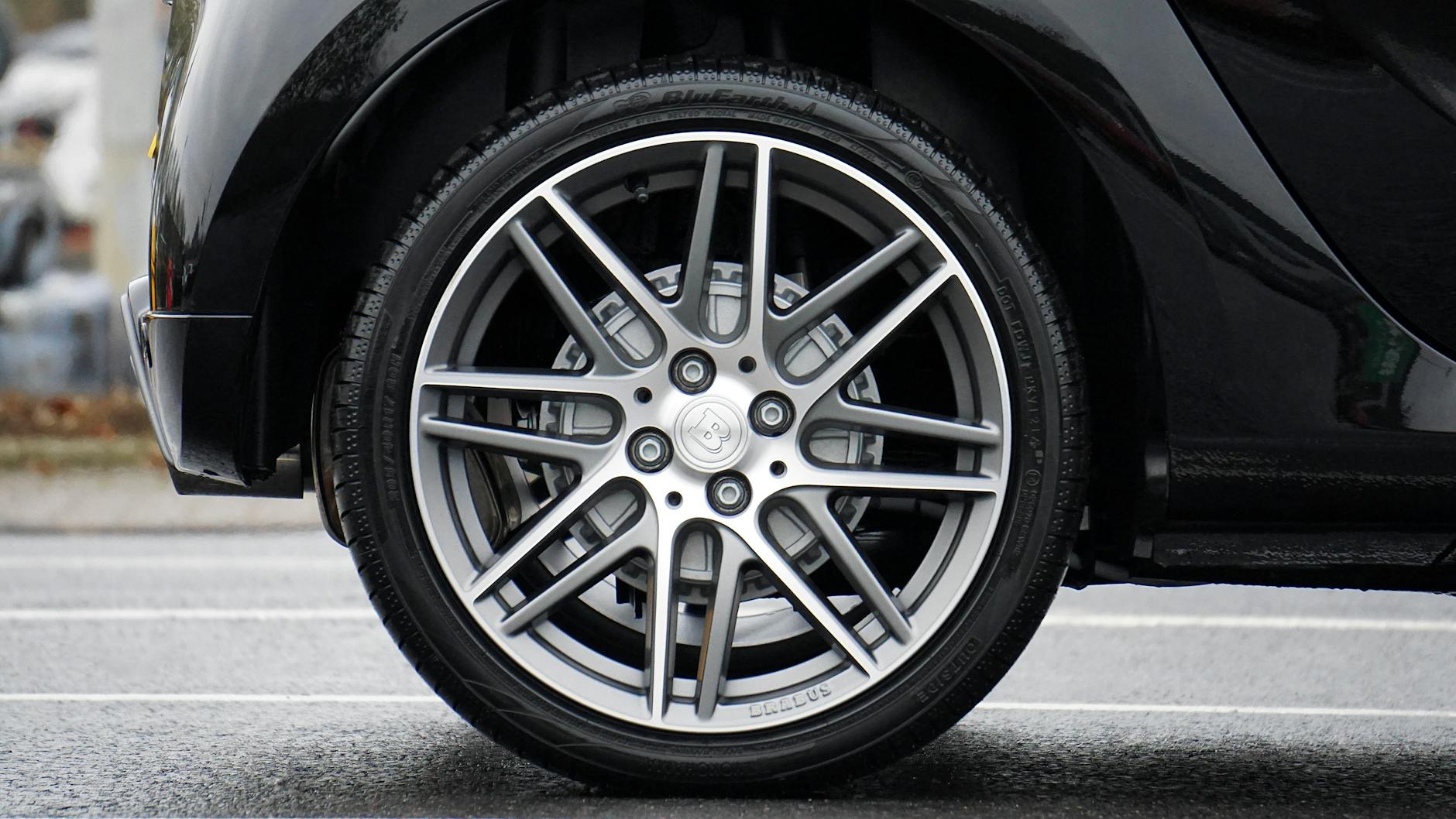
Monoblock (1-piece) forged wheels are cut from a single forged blank. They're the lightest option in most sizes, structurally the simplest, and the easiest to seal against corrosion since there are no joints. Most street performance builds—your Mustang GT with a Brembo BBK, your Stinger GT, your Model 3 Performance—are well served by monoblock construction. An 18×9.5 monoblock in a well-designed 5-spoke can realistically come in under 18 lbs, which represents a meaningful reduction from the 22–25 lb OEM cast wheel it replaces.
2-piece wheels combine a forged face with a spun or flow-formed barrel, joined by hardware around the rim flange. The joint is typically a series of stainless steel bolts spaced every 20–30mm around the perimeter, torqued to spec and sealed with silicone or anaerobic sealant. This construction lets you mix widths and offsets more flexibly without remachining a full blank, and it allows the face to be a separate forged component with greater design depth—a 2-piece can achieve more dramatic concavity than a monoblock because the face isn't constrained by what can be machined from a single blank's starting geometry. They run slightly heavier than monoblocks in equivalent sizes, typically 1–2 lbs per wheel due to the hardware.
3-piece wheels add a separate outer lip, bolted between the face and inner barrel. Maximum adjustability, great for fitment extremes like a stretched 265 on a 10-inch rear for a stanced E46, but the most joints to seal and typically the heaviest of the three constructions. The outer lip on a 3-piece can be swapped independently if it gets curbed—which is a real advantage for show cars and low-offset setups where the lip is exposed. They're also the format where barrel width changes are most practical after the fact, since you're essentially reassembling three discrete components rather than remachining a single piece.
Why Forging Matters for Performance
The weight reduction is the headline number. A cast OEM wheel on a 2022 Golf GTI might weigh 22–24 lbs per corner. A forged replacement in the same 18×7.5 size can come in at 14–16 lbs. That's 8 lbs per corner, 32 lbs total, all of it unsprung and rotational mass—the kind of weight that actually changes how a car feels over cast iron rotors or trunk weight never could.
Lower unsprung mass improves suspension compliance. The wheel follows road surface changes faster when it weighs less, which means better contact patch consistency and more accurate steering feedback. On a track car this is measurable in lap times. On a daily driver it's felt as a quieter, more planted ride at highway speeds.
Rotational inertia has an additional effect beyond simple mass. Because a wheel's mass is distributed at its outer radius, reducing wheel weight has a disproportionate impact on the energy required to accelerate and decelerate. Engineers express this as polar moment of inertia—a measure of resistance to rotational acceleration. A lighter wheel with mass concentrated closer to the hub (through thinner spokes and a lighter rim section) has a lower polar moment than a heavier wheel of the same diameter, which means the engine works less to spin it up and the brakes work less to slow it down. This is why wheel weight matters more than equivalent weight removed from, say, the trunk.
Strength matters too, though it's often oversold. A quality cast wheel won't explode on normal roads. What forging actually changes is fatigue life—how many stress cycles the material handles before microcracking begins. Aluminum alloys under cyclic loading develop microcracks that propagate slowly over time; the aligned grain structure of a forged wheel makes crack propagation significantly harder, because cracks have to work against the grain rather than along random crystal boundaries. For wheels that see track days, regular highway miles at high speed, or simply live in a climate with frost heave and pothole seasons, the longer fatigue life of a forged wheel is a real advantage over decades of ownership.
For a deeper look at the structural comparison, the forged vs cast wheels breakdown covers what actually changes in the metal and what's just marketing.
Fitment: The Part Most People Get Wrong
A wheel that doesn't fit properly ruins everything the forging accomplishes. Custom forged wheels give you full control over every fitment variable, but that's only useful if you know what to spec.
Diameter and width are the obvious ones. For most modern performance sedans and coupes, 18–20 inches is the practical range. Bigger looks more dramatic but adds rotational inertia and constrains tire selection. A 19×9.5 front and 19×10.5 rear staggered setup is popular on the S550 Mustang GT for good reason—it fills the arches without requiring a lift or major fender work. Going to 20 inches on the same car can look proportionally right but narrows your high-performance tire choices and often means a stiffer sidewall that punishes on rough roads.
Offset (ET) is where custom ordering earns its keep. Offset is the distance in millimeters from the wheel's mounting face to its centerline. A higher ET pushes the wheel inward (more tucked); a lower ET pushes it outward (more flush or poked). OEM offsets are conservative—manufacturers need clearance margins for suspension travel, steering lock, and brake hardware across multiple trim levels. A BMW G80 M3 ships with a front offset of ET22, which is already fairly aggressive, but many owners running aftermarket coilovers and wider front tires find ET16–ET18 fills the arch more satisfyingly without rubbing. A custom forged wheel can be spec'd to that exact figure because you're accounting for your specific suspension setup, not a spec that has to cover a base model with drum brakes.
When calculating offset for a wider wheel, remember that every additional 10mm of width added to the inside of the wheel (keeping the face position the same) increases the effective ET by 5mm. So if you go from a 9-inch to a 10-inch wheel and want the face to stay in the same position relative to the fender, you need to reduce the ET by 5mm. This is the arithmetic that separates a flush fitment from one that pokes 8mm past the arch.
Bore is the center hole diameter. A custom wheel is machined to your hub bore exactly, eliminating the need for hub rings entirely and ensuring the wheel seats precisely on the hub—which is how wheels are actually centered, not by the lug hardware. Hub-centric fitment matters because if the wheel seats on the lug bolts rather than the hub, the lugs carry lateral loads they weren't designed for. On a catalog wheel with a 74.1mm universal bore that gets ring-adapted down to a 66.6mm BMW hub, any ring failure under load transfers that centering function to the lugs. A custom-bored wheel eliminates that failure mode entirely.
PCD (bolt pattern) is fixed by your car. 5×112 for most VAG and Mercedes platforms, 5×114.3 for most Japanese and American performance cars, 5×120 for BMW and some GMs. Custom forging means your wheel is drilled to that spec—no adapters, no compromises.
If you're building a specific platform and want to go deep on the full setup including tire sizing, the custom wheels and tires setup guide covers how all of these variables interact.
Design: What You Can Actually Customize
With a fully custom forged wheel, the spoke design, spoke count, spoke shape, face concavity, lip depth, and finish are all variables. That's not a small thing.
Spoke design affects both aesthetics and structural efficiency. A 5-spoke split design distributes load differently than a 10-spoke mesh, and the CNC machining that creates those spokes is where most of the design character comes from. Brushed pockets, milled steps, chamfered edges—these details catch light differently and give a wheel its visual weight. Fewer, wider spokes tend to read as aggressive and contemporary; more spokes with thinner profiles read as classic or motorsport-influenced. The spoke cross-section profile also affects stiffness: a Y-section or T-section spoke resists bending more efficiently than a rectangular one of the same width, which is why some forged designs look visually delicate but measure well in radial load testing.
Face concavity is worth understanding before you order. A deep concave face creates the visual illusion of width and draws the eye to the dish behind the spokes. A flat or barely concave face reads as cleaner and more modern. Neither is objectively better—it depends on your car's proportions and your taste. A wide-body build with a large outer lip benefits from concavity that mirrors the depth of the fender extension; a more restrained OEM-plus build often looks cleaner with a shallow dish that doesn't compete with the car's body lines. The concave vs flat face wheel guide lays out when each choice makes sense.
Finish options on forged aluminum are extensive: machine-polished bare aluminum, matte or gloss powder coat in any RAL color, two-tone combos with brushed faces and painted barrels, anodizing for a hard surface layer with a metallic appearance. Powder coat on a forged wheel is more durable than on a cast wheel because the surface is denser and less porous—adhesion is better and chips are less likely to spread into corrosion. Anodizing, which converts the surface aluminum to aluminum oxide electrochemically, produces the hardest surface available on aluminum and resists brake dust staining better than any painted finish. It's limited to silver-to-black tones unless dyed, but for a wheel that prioritizes longevity over color variety, it's worth considering.
What Custom Forged Wheels Actually Cost
This is where a lot of people have calibrated expectations from legacy brands. A set of 19-inch monoblock forged wheels from a name like HRE, Vossen, or BBS typically runs $3,500–$7,000+ depending on size and design. That price reflects brand premium, retail distribution markup, and in some cases decades-old tooling amortization.
ForgedToFit works directly with a 15-year OEM forging partner—the same manufacturing infrastructure that supplies wheels to automakers—and sells direct. That removes the distribution chain entirely. A comparable set of custom forged wheels in 18–20 inch sizes typically lands 50–70% below legacy brand pricing while using the same forging process and 6061-T6 alloy specification.
Larger diameters and widths cost more because they start from a larger billet and require more machining time. A 20×11 costs meaningfully more to produce than an 18×8.5 in the same design—more raw material, more time at the lathe and mill, more waste aluminum from the pockets. Complex designs with deep pocketing, stepped faces, or very thin spokes also add machining time. Two-tone finishes requiring masking and dual powder coat runs add cost. None of these are arbitrary—they reflect actual production time.
The 5-year warranty covers structural defects. Not cosmetic damage from curbing (that's on you), but cracking, structural failure, and manufacturing defects—which, on a properly forged wheel, you should essentially never encounter.
The Ordering Process
Custom forged wheels involve more steps than pulling a set off a warehouse shelf, but the process is straightforward when it's designed well.
You start by browsing existing designs or submitting a reference image of something you want interpreted for your car. You provide your vehicle, your target fitment (or let us work from your specs and goals), and your finish preferences.
From there, we quote based on diameter, width, construction type, and finish. Once you approve the quote, the design goes to 3D CAD—you see a render of exactly what will be manufactured before the billet is touched. Revisions happen at this stage, not after machining. This is worth slowing down for: the render stage is where you catch that the spoke count looks off, or that you want the pockets milled deeper, or that the barrel proportion isn't matching your mental image. Changes to a digital file cost nothing; changes after machining cost material and time.
Manufacturing runs 4–8 weeks depending on queue and complexity. Wheels ship direct. Installation is straightforward if you have the torque specs and a proper torque wrench—lug seats on forged aluminum are machined precisely, so you want a calibrated tool, not a rattle gun. Aluminum lug seats are softer than steel, and over-torquing with an uncalibrated impact can gall the seat surface and make future removal difficult. Torque to the vehicle manufacturer's specification, not higher.
For platform-specific guidance on BMW fitments specifically, the BMW custom forged wheels guide covers offset considerations, brake clearances, and design choices across G and F-series platforms.
Who Custom Forged Wheels Actually Make Sense For
Not everyone needs a fully custom forged wheel. If you drive a stock Civic and want something that looks better than OEM without thinking about fitment, a quality aftermarket cast or flow-formed wheel does the job. The aftermarket wheels buyer's guide covers that category well.
Custom forging makes the most sense in a few specific situations. First, modified suspension: if you're running coilovers dialed to your preferred ride height, your actual fender clearances differ from factory spec, and a custom offset lets you fill those arches properly. Second, unusual fitments: widebody builds, cars with non-standard hub dimensions, trucks and SUVs with large brake packages. Third, weight sensitivity: track cars, autocross builds, sports cars where every rotating pound counts. Fourth, design specificity—you've seen exactly what you want and nothing on a shelf is it.
There's also a fifth case that comes up more often than people expect: high-brake-clearance builds. If you're running a big brake kit with 6-piston calipers and 380mm rotors, catalog wheels often don't clear the caliper body at a desirable offset. A custom forged wheel can be dimensioned with a specific spoke-to-barrel geometry that provides caliper clearance at the offset you actually want, rather than forcing you to stack spacers to push the wheel away from a caliper the catalog wheel was never designed to accommodate.
For a broader look at how to think through building a custom set from scratch, the custom rims guide walks through the decision process step by step.
A Note on Quality Verification
Not every wheel marketed as "forged" actually is. Some manufacturers start with a cast preform and flow-form the barrel—that's a legitimate and worthwhile process (see flow forming above), but it's not fully forged. Some use lower-grade alloys than 6061-T6. Some skip JWL/VIA certification testing entirely.
Things to verify before ordering from any custom forged wheel manufacturer: the alloy specification (6061-T6 or 6082-T6 for structural applications), whether they use a rotary forging press or a drop forge for the initial compression, whether wheels are JWL or TÜV certified, and whether the warranty is backed by the manufacturer directly or a third party. JWL certification specifically requires radial load, lateral load, and impact testing to defined standards—a wheel that passes those tests has been physically stressed to verify it won't fail under the loads it will actually see in use. TÜV certification adds an independent third-party audit layer on top of the manufacturer's own testing.
Ask for the forging partner's name or history—a 15-year OEM supplier relationship is verifiable in a way that marketing copy isn't. OEM suppliers are audited regularly by automakers who cannot afford warranty claims on wheels. That audit history doesn't disappear when the same facility produces aftermarket parts, which is why OEM-tier manufacturing provenance is worth asking about specifically rather than accepting "forged aluminum" as a self-certifying claim.
Frequently asked questions
How long does it take to get custom forged wheels made?
Typically 4–8 weeks from order confirmation through manufacturing and shipping. The 3D CAD design phase happens before manufacturing begins, so any revisions don't extend production time—they're handled upfront.
Are custom forged wheels street legal?
Yes. Properly manufactured forged wheels meet or exceed JWL and VIA structural standards, which are the same benchmarks OEM wheels are held to. If your wheel supplier can provide JWL or TÜV certification documentation, you're covered for both street use and most track day requirements.
Can I spec a custom offset that's different from OEM?
That's one of the primary reasons to go custom. You can spec an offset that's 10–20mm lower than OEM to push the wheel flush with your fender, as long as you've verified clearance at full steering lock and maximum suspension compression. If you're on stock suspension, give us your fender gap and we can recommend an offset. On coilovers, measure your actual clearances.
How much lighter are custom forged wheels compared to OEM?
Typically 5–10 lbs lighter per wheel compared to OEM cast wheels in the same size. A factory BMW 19-inch wheel often runs 22–24 lbs; a forged equivalent in the same diameter and width can be 14–17 lbs. The exact number depends on spoke count, face design, and barrel width.
What's the difference between a custom forged wheel and a semi-custom?
A semi-custom wheel starts from a standard forged blank in a fixed size and lets you choose finish, color, or minor machining variations. A fully custom forged wheel is machined to your exact diameter, width, offset, and bore from a billet sized specifically for those dimensions. The latter gives you complete control over fitment and usually a wider range of design options.
Do custom forged wheels work with TPMS sensors?
Yes. TPMS sensors mount to the valve stem or strap to the wheel interior—neither requires specific wheel construction. Most custom forged wheels are drilled for standard snap-in or bolt-in valve stems compatible with OEM and aftermarket TPMS sensors. Just confirm with your installer that the valve hole diameter matches your sensor type before mounting.