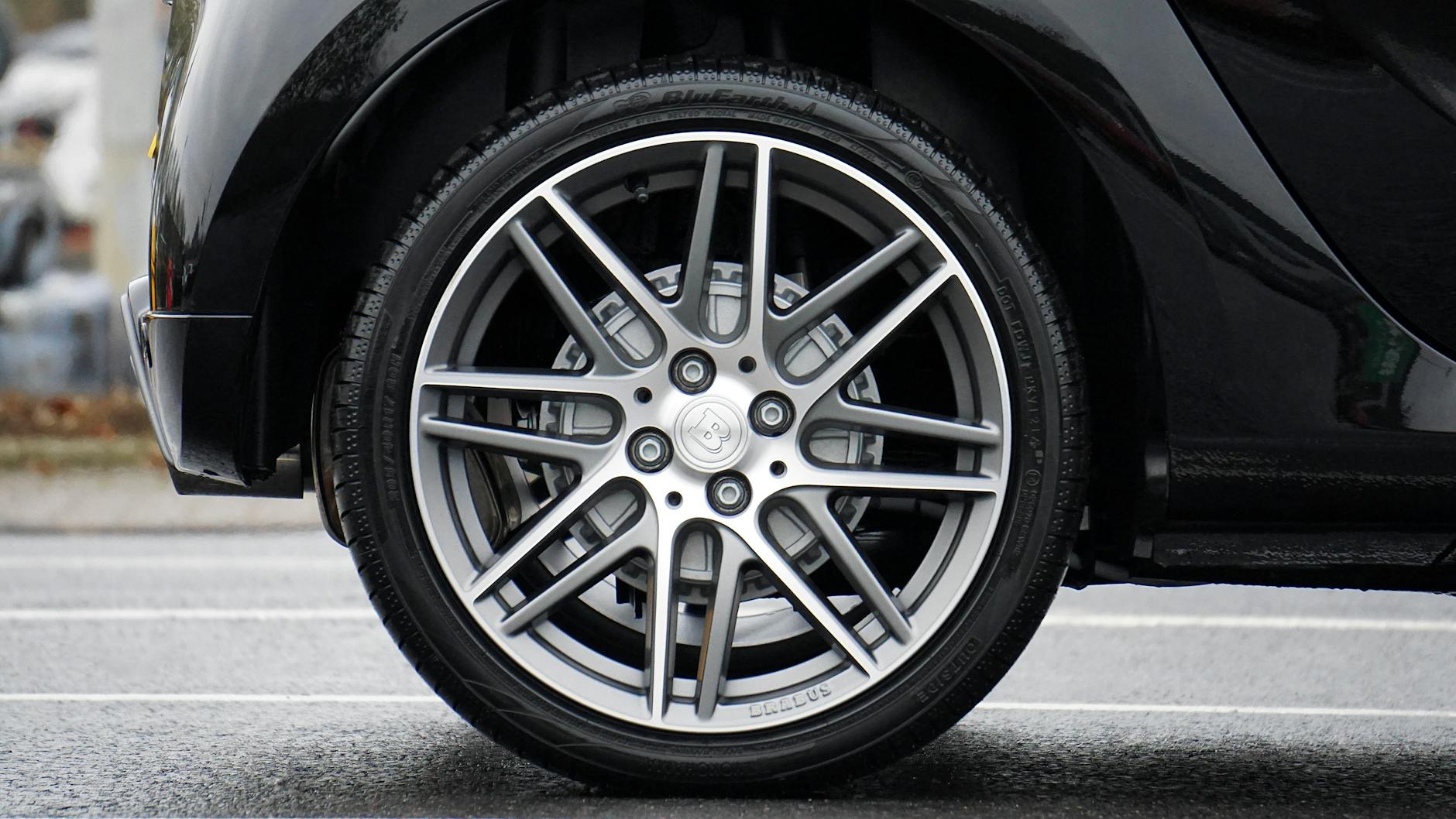
Forged Aluminum Wheels: What They Are and Why They're Worth It

Forged aluminum wheels sit at the top of the wheel manufacturing hierarchy for one straightforward reason: the metal is denser, more precisely aligned at a molecular level, and significantly lighter for a given strength rating than anything you can cast. That's not marketing — it's metallurgy. But the term gets thrown around loosely enough that it's worth breaking down exactly what forged aluminum means, how the process works, and where it actually pays off on a real car.
What Makes a Wheel "Forged"
Forging starts with a solid billet or ingot of 6061 or 7075 aluminum alloy. That blank gets heated — typically to around 400–450°C — and then compressed under extreme hydraulic pressure, anywhere from 5,000 to 10,000 tons depending on the press and wheel size. The grain structure of the aluminum doesn't just reshape; it flows and aligns with the contours of the die. The result is a blank with a continuous, uninterrupted grain flow that follows the shape of the wheel, rather than the random crystalline structure you get from pouring molten metal into a mold.
That grain alignment is the whole story. It's why forged wheels can be machined down to walls and spokes that would crack on a cast wheel. A forged 20-inch wheel for a Mustang GT can come in under 22 lbs per corner. A comparable cast wheel in the same size might weigh 28–30 lbs. That's 24–32 lbs of unsprung rotational mass saved across a full set — which you'll feel in steering response, throttle pickup, and braking distance.
6061 vs 7075 Aluminum: Which Alloy?
Most forged wheels are built from 6061-T6 aluminum. It's the industry standard — machines cleanly, takes finishes well, and has excellent corrosion resistance. The T6 designation refers to the temper process: solution heat treated and then artificially aged to peak hardness. In practice, 6061-T6 delivers a tensile strength of around 310 MPa and a yield strength of 276 MPa — numbers that position it firmly in performance territory while remaining practical to machine and finish at scale.
7075 is aircraft-grade, with roughly 40% higher tensile strength, but it's harder to machine, more sensitive to corrosion without proper anodizing or coating, and more expensive throughout the supply chain. Some motorsport-specific wheels — think dedicated time-attack builds, GT3-class racing, or hillclimb cars where grams are currency — use 7075 for maximum weight reduction at the same load rating. The Porsche 911 RSR's BBS center-lock wheels and some HRE racing applications use 7075 precisely for this reason. But for street and track day use, 6061-T6 hits the right balance. If a manufacturer doesn't specify the alloy, ask — vague answers here usually mean generic castings dressed up with forged-adjacent language.
Forged vs Cast: The Performance Gap
Cast wheels — even the low-pressure cast and gravity cast variants — start with aluminum in liquid form. Pour it, let it cool, machine it down. The problem is porosity: microscopic air pockets form during cooling, creating weak points in the structure. Manufacturers compensate by adding material, which adds weight. A well-made low-pressure cast wheel is a perfectly reasonable product, but it will always carry a weight penalty versus a forged equivalent.
The structural difference shows up most clearly under repeated stress. Cast wheels develop fatigue cracks from the inside out — those invisible porosity sites act as stress concentrators under cornering and braking loads. Forged wheels don't have that initiation mechanism. Their grain-aligned structure means cracks have to work against the metal's natural fiber direction, which is significantly harder. That's not an abstract benefit: it's why forged wheels are mandatory in professional motorsport categories where wheel failure carries life-safety implications.
Flow forming (also called flow forging or rotary forging) is the middle ground. You start with a cast blank, then roll-form the barrel under heat and pressure, which work-hardens the aluminum and increases tensile strength in the barrel specifically. The face is still cast. For a detailed breakdown of where each process makes sense, the flow formed vs forged wheels comparison covers the tradeoffs in depth. The short version: flow formed is excellent for the price point, fully forged is the right call when weight is the priority.
For a broader look at the case for forging over casting across different use cases, forged vs cast wheels gets into the structural specifics.
How Forged Aluminum Wheels Are Made (The Actual Process)
Here's the manufacturing sequence for a monoblock forged wheel:
- Billet preparation — aluminum ingot is cut to weight, inspected, and preheated
- Press forging — blank is compressed under the forging die to create the near-net shape
- Heat treatment — T6 temper process (solution heat treatment + artificial aging) to maximize hardness
- CNC machining — 3–5 axis CNC removes material to final dimensions; spoke profiles, bolt circle, center bore, and hub face are all cut here
- Finishing — machined surface gets polished, powder coated, painted, or brushed depending on spec
- Load testing and QC — radial load, cornering load, and impact tests per JWL or TÜV standards
The CNC machining stage is where the real engineering happens and where custom fitment is dialed in. The near-net forged blank is typically oversize by 3–5mm in critical areas, leaving enough material for the CNC to define exact spoke geometry, taper angles, and face depth without compromising structural walls. A five-axis machine can cut complex concave profiles and undercut spoke roots that a three-axis setup can't reach — which is why high-end forged manufacturers invest in five-axis capacity specifically.
Unlike a cast wheel that needs a new mold for every diameter and offset variation, a forged blank can be machined to exact specs: your exact bolt pattern, center bore, offset, and width. An F30 335i running a staggered setup — say, 19x8.5 ET35 front and 19x9.5 ET22 rear — can be cut to those exact numbers without compromise. That precision matters more than most people realize, especially on platforms with tight clearances like the G87 M2 or C8 Corvette, where a 2mm offset error can put a spoke against a caliper bracket or cause tire contact under full compression.
Weight Savings: What They Actually Mean on the Road
Unsprung weight is the mass that the suspension has to manage without the help of springs and dampers — wheels, tires, brakes, hubs. Every pound you remove from that rotating mass has an outsized effect compared to removing weight from the chassis. Some engineers use a 1.5x multiplier: 1 lb of unsprung rotational weight is roughly equivalent to 1.5 lbs of sprung weight in terms of handling effect.
At 6 lbs saved per corner (a realistic number comparing a 20-inch forged vs cast in a proper fitment), you're looking at an effective reduction of ~36 lbs of chassis weight in handling terms. On a sport sedan or performance coupe, that's real — sharper turn-in, faster transient response, and a more communicative steering feel that's harder to quantify but immediately obvious back-to-back. Drivers who've swapped OEM cast wheels for forged equivalents on BMWs and Porsches consistently report that the car feels more alert, not just lighter — because the suspension can track road surface changes faster when it isn't hauling as much wheel mass through each cycle.
Braking improves too. Less rotational inertia means the wheel speed drops faster when you apply the brakes — effectively shortening stopping distances and reducing thermal stress on the rotors at the same time. On track, where repeated hard braking is cumulative, that thermal benefit extends brake pad and rotor life in a measurable way.
Acceleration also benefits, though it's the least discussed. Reducing rotating mass at the wheel lowers the effective drivetrain inertia — the engine has less mass to spin up with each gear change. On a 300-400 hp platform, the effect won't show on a dyno, but it contributes to the sensation of a more responsive throttle and snappier rev matching.
Custom Forged Aluminum: The Fitment Advantage
Stock wheels are designed around manufacturing economics. Automakers need wheels that fit the broadest possible production range with the fewest SKUs. That often means generic offsets, conservative widths, and weight targets that balance cost against performance. A custom forged wheel starts from your exact fitment.
On a Mustang GT with a Brembo package, you need a minimum of 68mm of brake clearance at the inside face — a number that eliminates a lot of catalog designs. On a Model 3 Performance, the aero requirements at the front axle affect spoke geometry in ways that matter to range and thermal management of the front brakes. On a stanced G82 M4, you're working with 19x10 fronts and 20x11 rears with aggressive offsets that no shelf wheel hits precisely. Custom forged solves all three scenarios because the wheel is built to your specs, not adapted from an existing design.
The same logic applies to vehicles with unusual bolt patterns or hub bore requirements. A Lexus IS500 with a 5x114.3 bolt circle and a 60.1mm center bore needs to be matched exactly — a sloppy center bore fit transfers load to the lug hardware instead of the hub shoulder, which is a long-term reliability problem. Custom forged manufacturing eliminates that concern because your hub dimensions go into the CNC program directly.
If you want to walk through the full process — from choosing a design to confirming fitment specs before manufacture — custom car wheels: how to choose, order, and get it right lays out every step.
Design Considerations Specific to Forged Aluminum
Because forged aluminum is strong enough to be machined thin, you have design freedom that cast wheels don't allow. Spoke designs that would be structurally marginal in cast aluminum are routine in forged — sharp-edged split spokes, heavily concave faces, ultra-thin Y-spokes, and open mesh patterns with minimal material between voids. The same load rating that requires thick, gently radiused spokes in cast can be achieved with dramatically thinner profiles in forged because the material's fatigue resistance compensates for the reduced cross-section.
The face profile is worth thinking about carefully. Deep concave designs look dramatic on wide fitments and complement low-profile tires well — the visual depth is amplified by wide-body setups and aggressive camber. Flatter faces suit narrower applications and certain classic aesthetics, particularly on heritage-influenced builds where a muscle car or vintage European look is the target. The concave vs flat face wheels breakdown is useful if you're still deciding on profile.
Finish options expand with forged as well. Because the surface is denser and more uniform than cast, paint adhesion is better and polished finishes hold longer without micro-pitting. Brushed aluminum on forged has a visible grain depth that cast can't replicate — the parallel lines from machining follow the metal's own grain, which gives it a different quality of look under light. In direct sun, a brushed forged wheel has a subtle directionality and depth that's immediately distinguishable from the flatter look of brushed cast.
Window machining — cutting material from between spokes to create pockets that reduce weight without changing the external profile — is another technique that's only practical on forged. You're removing metal from inside a spoke section that's already carrying load; cast aluminum would fracture at the edges of those cuts under impact. Forged handles it because the grain flows continuously through those areas.
Spoke count affects both weight and stiffness. Fewer spokes means more material per spoke for the same load rating — easier to make dramatically light, but stiffer laterally and more susceptible to transmitting road harshness directly through the wheel to the tire sidewall. More spokes distribute load over a wider area, which can smooth out the ride slightly on rough surfaces and also gives the wheel a more traditional, refined aesthetic. For most street and track dual-purpose builds, 5 to 10 spokes hits the right range. Dedicated track wheels often go to 5 or 6 for minimum weight; daily-driven builds tend toward 7–10 for the combination of looks and road manners.
OEM Forging Partners and Why They Matter
The quality of a forged aluminum wheel comes down to press capacity, alloy sourcing, and CNC tolerance. OEM forging suppliers — the factories that produce wheels for BMW M, Porsche, and Mercedes AMG's performance lines — operate presses in the 8,000–10,000 ton range with strict incoming material traceability and CNC tolerances of ±0.1mm or tighter. That infrastructure doesn't disappear when they run an aftermarket order. It's the same equipment, same alloy certifications, same QC process.
Traceability matters more than most buyers realize. An OEM-tier supplier maintains heat number records for every billet — meaning if a batch of aluminum fails a downstream test, every wheel produced from that material can be identified and pulled. Aftermarket manufacturers without that documentation chain can't offer the same assurance. When a wheel is carrying the load of a 4,000-lb vehicle through a hard corner at speed, that accountability structure is part of what you're paying for.
That's the distinction between genuine OEM-tier forged production and low-cost alternatives that use the word "forged" loosely. Ask any supplier for their forging press capacity, the alloy spec with heat number traceability, and their test certifications (JWL/VIA, TÜV). JWL is the Japanese standard and is widely accepted; TÜV certification from Germany carries additional weight for European-market vehicles and is among the most demanding impact and radial load test protocols in the industry. The answers will tell you quickly whether you're looking at real forged aluminum or something dressed to sound like it.
When Forged Aluminum Is Worth the Investment
For purely ornamental builds — a show truck that sees no road miles — the weight advantage is irrelevant and a well-finished cast wheel is a reasonable choice. But for any car that gets driven, especially one that sees spirited driving, track days, autocross, or even daily highway miles in a sport sedan, forged aluminum pays back in several concrete ways:
Handling and feel — the weight reduction is perceptible, not theoretical, on any car with a chassis tuned to respond to it. An F80 M3 or Cayman GT4 will communicate differently through forged wheels, with a directness and immediacy that's immediately obvious in back-to-back testing.
Durability — forged aluminum handles pothole impacts without cracking at the strength levels where cast would fracture. The grain alignment that gives it tensile strength also gives it better fatigue resistance over time, particularly relevant for cars driven on poor urban road surfaces year-round.
Repairability — minor curb damage is easier to machine out on forged because the metal is denser and more consistent through its cross-section. Cast wheels with the same superficial damage often have sub-surface cracks that make repair structurally unsafe, because the impact that curbed the face also propagated cracking through the porosity network inside.
Resale and longevity — a properly finished forged wheel on a good platform holds up aesthetically and structurally for 100,000+ miles. The 5-year warranty coverage that serious manufacturers back their forged products with reflects genuine confidence in fatigue life, not just cosmetic durability.
The complete guide to forged wheels expands on the broader category if you want the full picture before committing to a spec.
Pricing Reality
Legacy forged wheel brands — BBS, HRE, Vossen Forged, Forgeline — sell sets in the $3,000–$8,000+ range, and in some cases significantly more for complex designs or rare fitments. The forging itself doesn't cost that much. You're paying for distribution markup, dealer margins, brand licensing, and the overhead of maintaining a US or European retail operation. Direct-to-consumer manufacturing through an established OEM forging partner cuts that chain dramatically — 50–70% is a real number when you remove four layers of margin from the supply chain.
That cost structure is worth understanding if you're shopping on a specific budget. A $1,800 set of forged wheels from a direct-to-consumer OEM supplier using the same press and alloy as a $4,500 branded equivalent isn't a compromise — it's a distribution model difference. The relevant questions are always about alloy spec, press capacity, certifications, and warranty terms, not brand recognition.
For a platform like a C8 Corvette or a G80 M3, where the OEM wheel is already excellent and light by factory standards, the argument for forged aftermarket is primarily weight savings at the margin and aesthetics. For cars where the stock wheel is heavy and generic — a base Mustang GT running 18-lb factory cast wheels, a standard Model 3, most mid-trim sport sedans — the performance case is strong and the economics make it easier to justify.
If you're building out a complete setup including tires, the custom wheels and tires setup guide covers how to spec tire dimensions around forged wheel fitments correctly, which matters more than most people expect when you're running aggressive offsets or non-stock widths. Getting the tire's load index and sidewall height right for a wider, lower forged wheel is the last step in making the full system work as intended.
Frequently asked questions
Are forged aluminum wheels actually stronger than cast?
Yes, measurably. Forging aligns the grain structure of the aluminum along the contours of the wheel, eliminating the porosity and random crystalline structure you get with casting. For a given strength rating, forged aluminum can be machined significantly thinner and lighter than cast. Tensile strength of 6061-T6 forged aluminum runs around 310 MPa versus 220–260 MPa for typical low-pressure cast alloys.
How much lighter are forged aluminum wheels compared to cast?
It depends on the design, size, and cast wheel you're comparing against, but a realistic range is 4–8 lbs per wheel lighter for a forged equivalent in the same size and design. On a 20-inch fitment for a sport sedan, a well-designed forged wheel often comes in at 21–24 lbs versus 27–32 lbs for a comparable cast wheel. Across a full set, that's 16–32 lbs of unsprung rotational mass removed.
What's the difference between forged and flow formed wheels?
Forged wheels start from a solid billet compressed entirely under a forging press. Flow formed (or flow forged) wheels start with a cast blank and then roll-form the barrel under pressure, work-hardening the barrel while leaving the face cast. Flow formed is lighter and stronger than standard cast, but doesn't have the full grain alignment or weight ceiling of a fully forged wheel. For most street performance use, flow formed is excellent value. If you're optimizing for absolute weight, full forged is the right call.
Can forged aluminum wheels be made in custom sizes and offsets?
Yes — this is one of the main advantages over catalog cast wheels. Because final dimensions are CNC-machined from the forged blank, the bolt pattern, center bore, offset, and width can all be cut to exact spec. A staggered fitment on an F30 335i, a wide-body clearance setup on a Mustang, or the precise brake clearance requirements of a Brembo-equipped platform are all achievable without compromise.
How do I know if a wheel is genuinely forged vs just marketed as forged?
Ask for the forging press capacity (genuine OEM-tier presses run 5,000–10,000 tons), the alloy specification with heat traceability (6061-T6 or 7075-T6 with documentation), and load test certifications like JWL/VIA or TÜV. A supplier that can't answer those questions specifically is probably selling flow formed or cast product under loose marketing language.
Do forged aluminum wheels require special maintenance?
No more than any quality alloy wheel. Regular washing to remove brake dust and road salt, avoiding harsh alkaline cleaners that can pit the finish, and periodic inspection for curb damage is the standard care routine. Because forged aluminum is denser, minor cosmetic damage like curb rash is often repairable by a qualified wheel refurbisher without structural risk — something you can't always say about cast wheels with similar damage.