Forged Monoblock Wheels: What They Are and Why They Matter

A forged monoblock wheel is exactly what the name says: one piece, forged from a single aluminum billet, machined to final shape. No center bolted to a barrel. No welded lip. No hidden stress points where two sections meet under load. The entire wheel — spokes, barrel, lip, hub — comes from one continuous grain structure. That's the core reason serious builders reach for them, and it's also why they've historically commanded prices that made enthusiasts wince.
That price gap is shrinking. But before we get into that, it's worth understanding exactly what separates a forged monoblock from everything else on the market, because the differences are more meaningful than most wheel marketing suggests.
What "Forged Monoblock" Actually Means
Forging starts with a solid aluminum billet — typically a 6061-T6 or 7075-series alloy — that gets compressed under thousands of tons of force. The compression aligns the aluminum's grain structure directionally, producing a wheel that's dramatically denser and stronger than anything poured into a mold. Cast wheels have random grain structure; forged wheels have intentional, aligned grain structure. That's not marketing. It's metallurgy, and it directly affects how the wheel behaves under impact and fatigue loading.
"Monoblock" means the entire wheel comes from that single forging. Two-piece wheels (a forged center mated to a spun or rolled barrel) and three-piece wheels (center plus inner and outer barrel sections bolted together) offer their own advantages — mostly fitment flexibility and the ability to rebuild sections — but they introduce seams and fastener points that a monoblock doesn't have.
With a monoblock, structural integrity is as clean as it gets. The spoke roots flow directly into the barrel without interruption. There's no gasket, no weld bead, no ring of bolts holding things together under cornering load.
The Manufacturing Process Step by Step
A quality forged monoblock starts as a round aluminum billet, typically 6061-T6. It goes into a forge press — ForgedToFit works with a 15-year OEM forging partner running presses in the 4,000–10,000 ton range — where the billet is compressed into a rough wheel shape called a preform. That preform still doesn't look like much. Then CNC machining removes material until the final design emerges: spoke geometry, face profile, backspacing, hub bore, lug pattern, all cut to precise tolerances. Heat treatment follows to maximize hardness. Then finishing — whether that's a brushed face, gloss black, two-tone machined, or a custom powder coat.
The entire process is why forged monoblocks used to cost $800–$1,500 per wheel from legacy brands. The machining time alone is significant. But when you eliminate the middleman margins stacked into brand-name pricing and go direct from manufacturer, those numbers look very different.
Forged Monoblock vs Two-Piece vs Three-Piece
Each construction has a reason to exist. Understanding the trade-offs helps you buy smart.
Two-piece forged wheels combine a forged center with a rolled or spun barrel, usually welded or bolted together. The main advantage is fitment flexibility — you can pair a wide variety of offsets and widths with the same center design without retooling the forging. For fitment-critical builds like a stanced E92 M3 or a tucked Mustang GT, two-piece construction gives builders options. The downsides: added weight from the connection hardware and weld material, and potential for leaks at the barrel joint on older or damaged wheels.
Three-piece forged wheels go further: a forged center, plus separate inner and outer barrel sections bolted through a ring of hardware around the lip. The classic choice for show builds because you can run extreme widths and swap lips for different looks. They're also serviceable — if you curb a lip, you replace that section rather than the whole wheel. But they're heavier, more expensive to build well, and the bolt ring is another variable to maintain.
Forged monoblock wins on structural simplicity and typically on weight for a given size. There's less total material because there's no center hardware or weld seam adding mass. A properly designed forged monoblock in 18x9 can come in under 20 lbs — sometimes significantly under, depending on spoke count and design. That matters for unsprung and rotational mass, which affects steering feel, ride quality, and acceleration response in ways that are genuinely noticeable behind the wheel.
For daily drivers and track cars where outright fitment flexibility matters less than weight and strength, monoblock is usually the right answer. For show cars requiring ultra-aggressive fitment or frequent width changes, multi-piece makes more sense.
Weight and Strength: The Real Numbers
Let's be specific. A cast wheel in 18x8.5 — the kind that comes stock on a lot of sport sedans — typically weighs 22–26 lbs depending on design and casting quality. A flow-formed wheel of the same size might hit 19–22 lbs. A forged monoblock, properly designed, can get to 17–20 lbs. On a four-wheel set, that's potentially 20–30 lbs of unsprung mass reduction. Every pound of unsprung weight removed has a larger effect on handling than a pound removed from the sprung mass (the body).
Strength comparisons are harder to quote in simple numbers because they depend on alloy, heat treatment, and design geometry. What the data consistently shows is that forged aluminum, at equivalent weight, outperforms cast in fatigue resistance and impact strength. Forged wheels don't crack the same way cast wheels do under repeated load cycles. They're more likely to deform visibly before catastrophic failure, which is the behavior you want.
For platforms that spend time on track — an F30 335i on a performance driving day, a Cayman S on a road course, a Model 3 Performance doing canyon runs — the fatigue resistance of forged construction isn't theoretical. It's the difference between a wheel that develops a hairline crack after 20,000 track miles and one that doesn't.
Fitment: Getting It Right on a Monoblock
Because a monoblock is machined as one piece, fitment decisions are locked in at the design stage. You spec the diameter, width, offset, hub bore, and bolt pattern before manufacturing starts. There's no adjusting offset by swapping barrel sections later. This makes the upfront fitment conversation critical.
For a BMW F30 335i: factory wheel specs run 18x8.5 front, 18x9 rear with a 245/40 and 255/40 respectively. A forged monoblock upgrade might go 18x9 square or step up to 19x9 front, 19x9.5 rear with an ET35-40 offset range. The hub bore needs to match BMW's 72.6mm center bore exactly — not 73mm with a cheap ring sleeved in, but machined to 72.6mm.
For a Mustang GT (S550): the stock setup is 19x9 front, 19x9.5 rear. A forged monoblock upgrade might stay at those sizes but run a more aggressive offset to push the wheel closer to flush with the fender — ET30-35 on the rear is a common starting point depending on whether the car has been lowered. Hub bore is 70.5mm.
For a Tesla Model 3 Performance: OEM is 20x8.5 all around. Weight is particularly meaningful here because the Model 3's steering feel is already somewhat muted — lighter wheels sharpen it noticeably. Hub bore is 64.1mm, which many aftermarket wheels don't machine correctly without a hub ring. A properly machined forged monoblock eliminates that issue entirely.
The point: don't guess on fitment. Provide actual measurements — hub bore, bolt pattern, brake caliper clearance, and your suspension setup — before anything gets machined.
Design Options on a Forged Monoblock
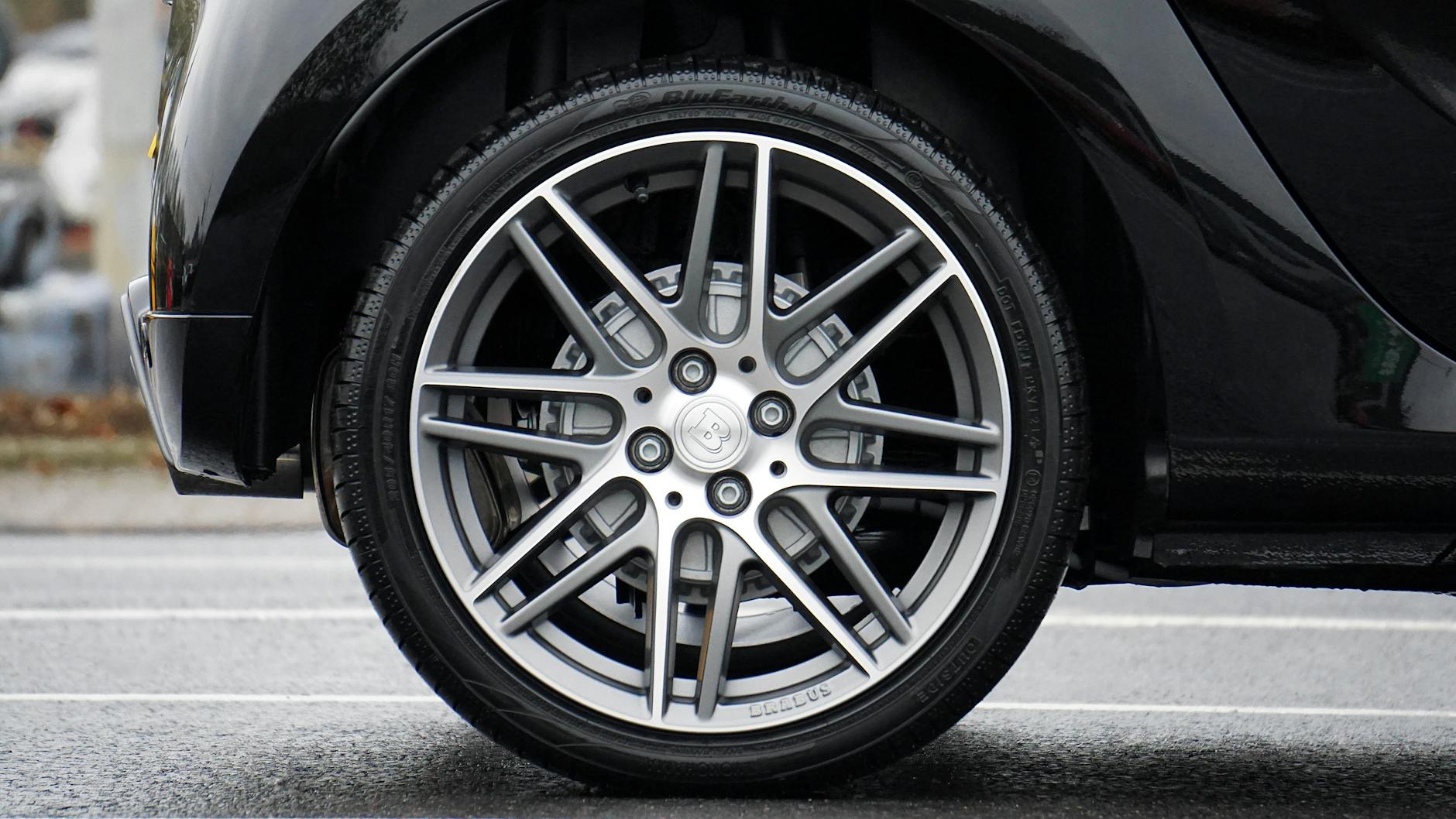
One misunderstanding about forged monoblocks is that they're limited to simple designs because of the machining constraints. The opposite is true. CNC machining from a forging blank can produce complex spoke geometries — Y-spokes, mesh-style, turbine-fan designs, concave face profiles, asymmetric spoke widths — with a precision that casting can't match. The spoke edges are crisp. The face geometry is consistent wheel to wheel.
Concave face profiles are worth calling out specifically. A deep concave on a forged monoblock requires more material removal (more machining time) but the structural result is excellent because the spokes are thicker at the roots where stress is highest and can taper toward the rim. Understanding how concave vs flat face wheels affect both aesthetics and engineering is useful context before you commit to a design.
Finish options are the same as any aluminum wheel: clear coat over brushed or polished, powder coat in any color, two-tone combinations with a machined face over a colored barrel, gloss or satin clears. The base material being forged doesn't restrict finishing options.
Cost: Why the Gap Has Closed
Legacy forged wheel brands — Vossen, BBS, HRE, Forgeline — build real product. They also carry brand premiums, dealer margins, and distributor costs that stack significantly onto the manufacturing price. A set of HRE monoblocks in 19-inch for an M3 runs $4,000–$6,000 or more. BBS FI-R or similar forged monoblocks land in that same range. The wheels are excellent. The price reflects a lot of non-wheel costs.
Direct-to-consumer manufacturing through a proper OEM forging partner — the same type of operation producing wheels for OEM programs — can deliver a forged monoblock at 50–70% less. The forging process, alloy, and CNC precision don't change. What changes is how many hands the wheel passes through and what margin each takes.
For the same 19-inch four-wheel set that runs $5,000 from a legacy brand, the manufacturing cost — direct — might be $1,500–$2,500 depending on design complexity and finish. That's a real difference, not a rounding error. And it comes with the same 5-year structural warranty you'd expect from a brand charging double.
If you want to understand the broader landscape of forged aluminum wheel pricing and construction, forged aluminum wheels: what they are and why they're worth it covers the material science and value case in more depth. And if you're still weighing forged against cast construction for your specific use case, forged vs cast wheels: what actually matters cuts through the noise.
How the Custom Order Process Works
At ForgedToFit, the process is straightforward: you browse existing designs or submit your own concept, we provide a quote, the design team does a 3D CAD render for approval, and then manufacturing and direct shipping. You're not ordering from a catalog — you're specifying a wheel built to your car's fitment and your design preferences.
The 3D CAD step matters. It lets you see exactly what the finished wheel will look like on your car's offset and width before a single gram of aluminum is cut. Spoke geometry, face depth, finish — all visible and adjustable before manufacturing locks in. Changes at the CAD stage cost nothing. Changes after forging cost a new wheel.
For anyone new to the custom wheel ordering process, custom forged wheels: the complete guide walks through what to expect at each stage, what information you need to have ready, and how to avoid the common mistakes that result in fitment problems or wheels that don't look right on the car.
Track Use and Warranty Considerations
Forged monoblocks are the correct choice for track use. The fatigue resistance, weight savings, and structural consistency matter more on circuit than anywhere else. That said, no wheel is indestructible. Curbing, pothole impacts, and hard contact with track curbing can damage any wheel — forged or otherwise.
A 5-year structural warranty covers manufacturing defects and material failures under normal use. It doesn't cover impact damage from hitting a concrete barrier at turn-in. This is standard across the industry, and it's worth being clear-eyed about. What forged construction does give you is a wheel that's less likely to fail progressively under the repeated stress cycles of track driving — which is the more common failure mode anyway.
For a car that's primarily a track tool — a dedicated E46 M3 track car, a 991 GT3 club sport, an FR-S autocross build — the weight and strength of a forged monoblock pays dividends every session. For a daily driver that sees a track day twice a year, it's still worth it, but the cost-benefit math is slightly less dramatic.
Comparing to Flow Formed
Flow forming sits between cast and forged in both cost and performance. A flow-formed wheel starts as a cast center, then a spinning process works the barrel under pressure, aligning the grain structure of the barrel section and thinning it. The result is lighter and stronger than a purely cast wheel, but the center — the structurally critical section where spokes meet hub — remains cast.
For budget-conscious builds where a full forged monoblock isn't the priority, flow formed is a legitimate choice. The flow formed vs forged wheels comparison is worth reading if you're weighing those two options. But for anyone prioritizing maximum strength-to-weight ratio, a forged monoblock is the more capable product — particularly in the spoke and hub area where cast construction is most limiting.
The price difference between flow formed and forged monoblock has also narrowed considerably at the direct-to-consumer level. When legacy brand premiums are out of the equation, forged monoblocks become competitive with flow-formed offerings from catalog brands — which changes the decision significantly.
Frequently asked questions
What is a forged monoblock wheel?
A forged monoblock wheel is machined from a single aluminum billet that has been compressed under high pressure to align its grain structure. The entire wheel — hub, spokes, and barrel — is one continuous piece with no welds or joints. This makes it lighter and structurally stronger than cast or multi-piece designs.
Are forged monoblock wheels worth it for a daily driver?
Yes, for most enthusiasts they're worth it. The weight savings over cast wheels reduces unsprung mass, which improves steering response, ride quality, and acceleration feel. The strength advantage also means they hold up better over rough roads and pothole impacts. The cost premium over cast wheels has dropped significantly with direct-to-consumer manufacturing.
How much do forged monoblock wheels cost?
From legacy brands, expect $800–$1,500 per wheel. Through a direct-to-consumer manufacturer like ForgedToFit — using the same OEM forging partners — a set of four can run 50–70% less, typically $1,500–$2,500 for a complete set in 18–20 inch sizes depending on design complexity and finish.
Can I run forged monoblock wheels on a track car?
Forged monoblocks are the preferred choice for track use. The aligned grain structure from forging resists fatigue cracking under repeated load cycles — the most common failure mode in track driving — and the weight savings reduce rotational mass for measurably better performance. A 5-year structural warranty covers manufacturing defects.
What's the difference between forged monoblock and two-piece forged wheels?
A monoblock is one machined piece with no seams or joints. A two-piece wheel has a forged center bolted or welded to a separate barrel. Two-piece designs offer more fitment flexibility since you can pair different offsets and widths with the same center, but they're typically heavier and have potential weak points at the joint. Monoblocks are simpler, lighter, and structurally cleaner.
How do I get the fitment right when ordering a custom forged monoblock?
You need to confirm bolt pattern, hub bore (measured precisely — not estimated), desired offset, width, and diameter before ordering. For cars with larger brake calipers, confirm clearance dimensions too. At ForgedToFit, a 3D CAD render is provided for approval before manufacturing begins, so you can verify fitment and design before anything is cut.