Forged Wheels for Sale: What to Know Before You Buy

Searching for forged wheels for sale is easy. Finding a set that's actually forged, properly spec'd for your car, and priced like it's 2025 instead of 2005 — that's where most buyers stumble. The legacy wheel brands have conditioned the market to accept $800–$1,200 per wheel as the entry point for genuine forging. That number is not a law of physics. It's a margin structure built on brand equity, distributor layers, and the assumption that you don't know any better.
This guide exists to fix that. We'll cover what forged wheels actually are, how to read specs, what to pay, which platforms benefit most, and how to spot the marketing sleight-of-hand that turns cast wheels into "forged-inspired" marketing copy.
What Makes a Wheel Actually Forged
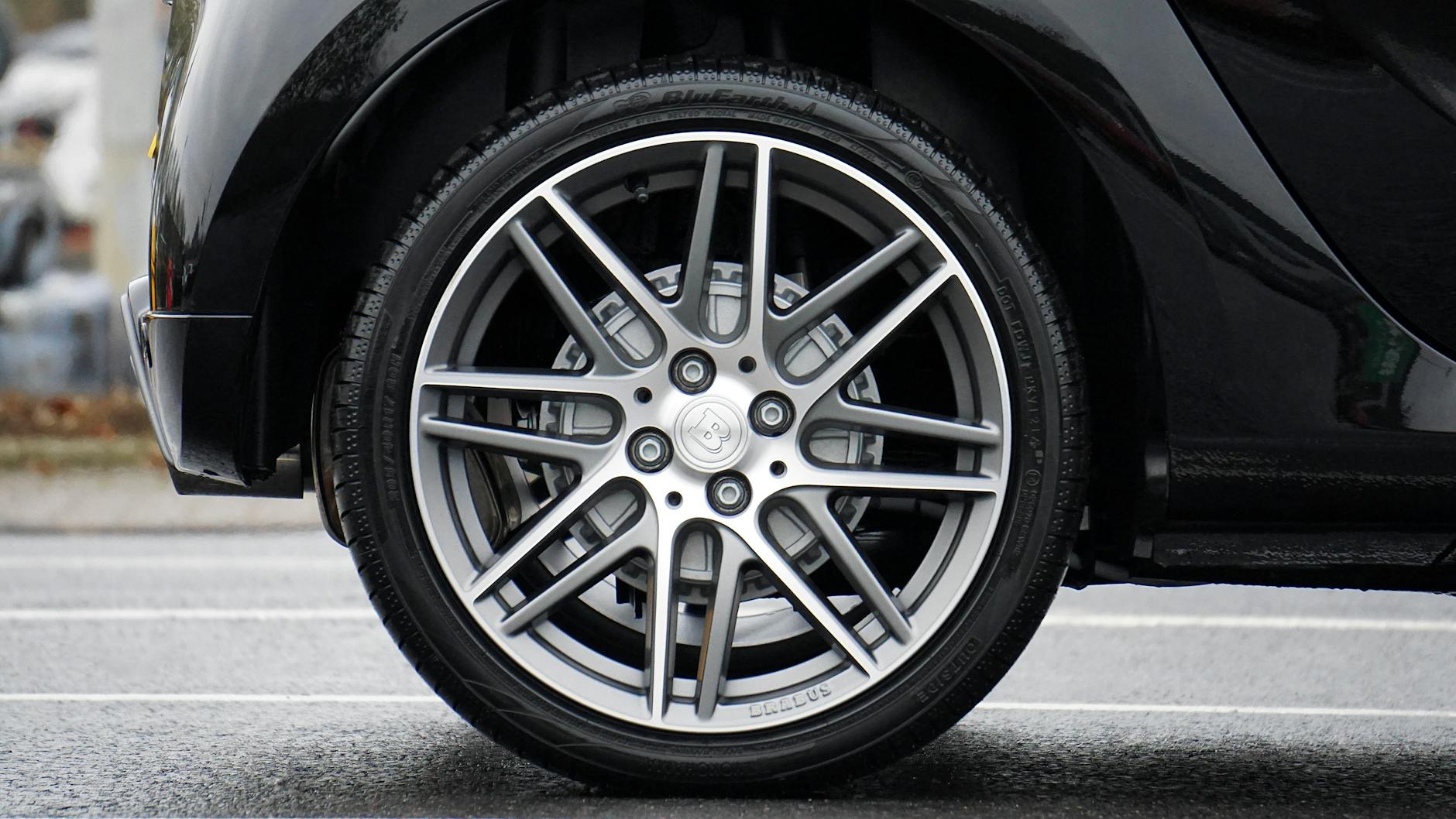
Forging starts with a solid billet of 6061-T6 or 6082-T6 aluminum alloy. That billet gets pressed — under 5,000 to 10,000 tons of force — into a near-net shape. The compression realigns the grain structure of the metal, producing a denser, more fatigue-resistant material than you can get by pouring molten aluminum into a mold. A cast wheel and a forged wheel can look identical. The difference is entirely in how the metal was processed, which determines how it behaves under load.
The practical result: a forged wheel can be machined thinner and lighter than a cast equivalent while meeting the same — or better — load ratings. A 19x9.5 flow-forged wheel for a Mustang GT typically comes in around 22–24 lbs. A comparable cast wheel in the same size runs 26–30 lbs. That 4–6 lb difference per corner is 16–24 lbs of unsprung mass off the car, which is felt in steering response, ride compliance, and brake cooling.
The physics behind that improvement are worth understanding. Unsprung mass — the weight of everything that moves with the wheel rather than being cushioned by the suspension — has an outsized effect on handling because the suspension has to control it dynamically. Reducing unsprung mass lets the suspension respond faster to road irregularities, keeps the tire in better contact with the surface, and reduces the rotational inertia the engine has to overcome during acceleration and the brakes have to scrub off during deceleration. A 5 lb reduction per corner sounds modest; the lap time and feel difference is not.
For a deeper dive on the manufacturing differences, the cast vs forged wheels breakdown covers the metallurgy without the fluff.
Flow Forming vs Full Forging
Two processes get sold as "forged" in the wheel market, and they're not the same thing.
Full monoblock forging starts and ends with compressed billet. The entire wheel — barrel, spokes, flange — is forged. This is the highest-spec option and what you'll find on OEM exotic wheels and high-end aftermarket sets. A full monoblock forged wheel requires multiple CNC machining passes to reach its final geometry, which is part of why the process is more expensive — but it's also why the spoke profiles can be thinner and more aggressive than any cast design can safely achieve.
Flow forming (also called flow forging or rotary forging) starts with a cast center and then spins and stretches the barrel under rollers at high pressure. The barrel gets the strength benefits of a work-hardened aluminum structure; the center remains cast. It's a legitimate process that produces a meaningfully better wheel than straight casting — typically 15–20% lighter for the same size — but it's not a full forged wheel. Both processes are valid. The problem is when a brand calls a flow-formed wheel "forged" without clarification.
There's also a third process worth knowing: multi-piece wheel construction, where a forged center is bolted or welded to a spun aluminum barrel. Two-piece and three-piece wheels built this way are genuine in their forged center claim, and the modular construction allows width and offset customization that's harder to achieve with monoblock designs. The tradeoff is more assembly points that require inspection over time, and a weight penalty compared to a monoblock of equivalent design. For track use where the wheel will be removed and inspected regularly, that's manageable. For a set-and-forget daily driver, monoblock is simpler.
At ForgedToFit, both full forged and flow-formed options are available and clearly labeled. The flow formed vs forged wheels comparison breaks down exactly when each process makes sense for your application.
Why Forged Wheels Cost What They Cost — and What They Should Cost
The price gap between forged and cast wheels is real, but it's been stretched far beyond what manufacturing economics justify. Full forging requires CNC machining time, harder tooling, and more material prep than casting. That legitimately adds cost. But a $900/wheel price tag from a legacy brand also includes:
- Distributor and dealer markup (often 40–60%)
- Brand licensing and marketing overhead
- Limited SKU strategy that forces you toward their catalog sizes
Working directly with an OEM forging partner — the same factories that supply some of the brands charging triple — eliminates those layers. That's why genuine forged wheels for sale through direct-to-consumer programs like ForgedToFit land at 50–70% less than names like HRE, Vossen, or BBS for equivalent construction quality. The forging partner has 15 years of OEM production history. The difference is who's sitting between you and the factory.
It's worth naming the specific cost structure that legacy brands have built. A wheel that costs $180–$220 to manufacture, test, and finish at an ISO-certified forging facility in Taiwan or China might wholesale to a regional distributor at $350. That distributor sells to an authorized dealer at $550. The dealer sells to you at $900. Every link in that chain is extracting margin from a product whose core manufacturing cost hasn't changed. The direct model compresses that to two steps: factory to buyer, with the brand operating as a thin coordination layer rather than a margin aggregator.
Reading Forged Wheel Specs for Your Car
Size, offset, and bolt pattern are the three numbers that determine whether a wheel fits. Getting one wrong means a set that looks perfect in a render but hits the caliper or pokes past the fender.
Diameter and width are the obvious starting point. An F30 335i runs 18x8.5 ET35 front and 18x9.5 ET35 rear as a common fitment. A C8 Corvette Stingray comes from the factory at 19x8.5 front, 20x11 rear — staggered, and those sizes matter when you're going custom. A Tesla Model 3 Performance is typically running 20x8.5 ET40 all around. Each platform has a fitment envelope, and it's tighter than most buyers realize.
Offset (ET) is how far the mounting face sits from the wheel's centerline. Higher ET pushes the wheel inward. Lower ET (or negative offset) brings the wheel out toward the fender. Going 10–15mm lower on offset than OEM is common for an aggressive stance; going much further without arch work or a wider track risks rubbing at full lock or under compression. When you lower a car on coilovers, the geometry of what clears at ride height can change significantly at full compression — a fitment that works at static ride height may catch the inner arch liner over sharp bumps. This is especially common on Volkswagen MQB platforms and Honda Civic Type R builds where the suspension travel geometry is tight.
Center bore must match the hub. Most aftermarket wheels use a hub-centric ring to fill the gap if the bore is slightly larger than the hub — that's fine. But if the bore is smaller, the wheel simply won't mount. BMW hubs run 72.6mm. Ford F-150 runs 87.1mm. Tesla Model Y runs 64.1mm. These details matter and should be confirmed before any order. Hub-centric rings should be aluminum or rigid nylon — cheap plastic rings can compress over time and allow the wheel to run slightly off-center, which produces a vibration that's maddeningly difficult to diagnose.
Bolt pattern is the final gating spec. 5x112 covers most modern BMW, Mercedes, Audi, and Volkswagen. 5x114.3 is the dominant pattern for Japanese and American performance cars — Mustang, Camaro, WRX, BRZ, 370Z, most Hondas. 5x120 covers BMW trucks and some GM applications. Tesla uses a proprietary 5x114.3 with an unusual lug seat angle on some models. Getting a wheel with the right pattern but wrong seat angle is a fitment failure that isn't obvious until the lug torques incorrectly.
For platform-specific fitment advice, the aftermarket BMW wheels guide and the aftermarket Tesla wheels guide go deep on common sizing.
Which Cars and Drivers Benefit Most from Forged
Not every application demands forged construction. Here's the honest breakdown.
Track use and performance driving — this is where forged wheels earn their keep hardest. Unsprung weight reduction is most noticeable at the limit. Forged wheels also handle the thermal cycling from hard braking better than cast, reducing the risk of stress cracking over time. If you're putting a car on a circuit, the weight savings are not cosmetic. A driver doing HPDE events or time attack in a lightly modified WRX STI or Civic Type R will notice the difference in corner entry response and brake fade threshold before and after switching from OEM cast to forged — not because the engine changed, but because the rotating mass the brakes have to control has dropped meaningfully.
Heavy daily drivers and performance SUVs — a Model Y or BMW X5 M50i carries a lot of mass, and the wheels are doing real structural work through every pothole and highway mile. The fatigue resistance of a forged wheel matters more over a five-year daily-driver cycle than it does on a weekend car that sees 3,000 miles a year. Cast wheels on heavy SUVs are more vulnerable to cracking from impact damage — a hard pothole strike that dents a cast wheel may only bend a forged one, which is often repairable where a crack is not.
High-power builds — a Mustang GT running 600whp on slicks is loading wheel spokes in ways the OEM cast wheels weren't designed for. Forged construction with proper load ratings is the right answer.
Show cars and mild street builds — this is where a quality flow-formed wheel often makes more practical sense. You get the visual and the weight benefit, at lower cost, without paying for fatigue properties your use case won't stress. A clean 19x9.5 flow-forged in brushed gunmetal on an F30 will look and perform better than most cast alternatives at the same price point.
What Forged Wheels for Sale Actually Look Like at ForgedToFit
The process here isn't pulling from a warehouse of pre-made SKUs. You choose a design or submit your own, we generate a 3D CAD render matched to your car's exact specs, confirm fitment, then manufacture. That means:
- Any diameter from 17" to 24"
- Any width and offset within your platform's fitment envelope
- Custom center bore to match your hub exactly
- Finish options including brushed, matte, gloss, two-tone, and machined face
- Full monoblock forged or flow-formed, clearly stated
The CAD confirmation step is more significant than it sounds. Because spoke depth, inner lip clearance, and offset interact in ways that aren't obvious from a spec sheet, seeing the wheel modeled against your car's hub, caliper, and arch dimensions before manufacturing catches fitment issues that would otherwise become expensive return problems. It's standard practice at ForgedToFit and should be a baseline expectation of any custom forged wheel program.
Lead time is longer than pulling a set off a shelf — typically 6–8 weeks from order to delivery. That's not a bug. That's what made-to-order manufacturing looks like. What you get is a wheel built for your car, not adapted to it.
The custom forged wheels guide covers the design and ordering process in full.
Spotting Fake "Forged" Wheels in the Market
This is worth a dedicated section because the misleading language is rampant.
Phrases to approach with skepticism:
- "Forged-style" — means cast, designed to look like forged. This is purely aesthetic.
- "Forged finish" — refers to a surface texture, not the manufacturing process. Completely unrelated.
- "Forged technology" — vague enough to mean almost nothing. Ask for the process explicitly.
- "Lightweight forged" — legitimately could mean flow-formed, but verify. Get the weight specs.
The real test is weight. A genuine full-forged 19x9.5 monoblock will typically come in at 20–23 lbs depending on spoke design. If a "forged" wheel in that size weighs 28+ lbs, the forging claim deserves scrutiny. Manufacturers of genuine forged wheels will provide weight data. If a brand doesn't publish weights, that's a red flag.
A secondary test is price. If a wheel is being marketed as full monoblock forged at $150–$180 per wheel in an 18–19" size, that price doesn't support the manufacturing process. Genuine forged production at ISO-certified facilities has hard floor costs in materials and machining time. A price that implies otherwise usually means the process isn't what the label says. This is common in no-name import listings on marketplace sites where the product photos show a clean-looking wheel but the spec sheet is vague or absent.
Ask for the T6 temper designation. Legitimate forged wheels specify 6061-T6 or 6082-T6. The T6 means the aluminum has been solution heat-treated and artificially aged — a process that brings the alloy to its peak strength. A wheel spec sheet that lists only "aluminum alloy" without temper designation is either using lower-grade material or not being fully transparent about what you're buying.
The forged wheels brands overview names names and gives honest assessments of who's delivering real forged construction versus marketing posture.
Forged Wheels for Trucks: A Different Calculation
Forged wheels for trucks involve different tradeoffs than for sports cars. Load rating is the dominant concern. A 3/4-ton truck like an F-250 with a payload and tow package can put enormous stress on a wheel set — stress that's less about peak lateral load (as in track cornering) and more about sustained fatigue from weight cycling over distance. The SAE load rating on a truck wheel needs to cover the wheel's share of GVWR, not just curb weight. On a dually configuration, the inner and outer wheel on each rear axle position are each carrying a fraction of that load, but on a standard single-rear-wheel 3/4-ton, each rear wheel may be supporting 1,500–1,800 lbs of combined vehicle, payload, and tongue weight. That number should drive your load rating selection before aesthetics enter the conversation.
For lifted trucks running 20x12 or 22x12 in negative offset for aggressive stance, the spoke geometry of a forged wheel matters. Deep negative offset creates significant leverage on the spoke roots. Flow-formed construction handles this well for most builds. Full forged makes sense on trucks used for serious towing or payload work at larger diameters.
The custom truck wheels guide covers load ratings, offset, and lifted fitment in detail.
Price Expectations in 2025
Real numbers help. Here's a realistic range for genuine forged wheels for sale in 2025, outside of legacy brand pricing:
- Flow-formed, 18–19", common bolt pattern: $250–$400 per wheel
- Full monoblock forged, 18–19": $350–$550 per wheel
- Full monoblock forged, 20–21", custom offset: $450–$700 per wheel
- Full monoblock forged, 22–24", truck fitment: $550–$850 per wheel
Compare that to HRE at $900–$2,000+ per wheel, or BBS FI-R at $700–$1,100, for wheels coming out of comparable forging processes. The difference is distribution and brand equity, not manufacturing quality.
A full set of custom forged 19" wheels for an F30 335i should run $1,400–$2,000 through a direct-to-consumer program. Through a legacy brand, you're looking at $3,500–$6,000 for the same construction. That gap is real, and it's available to any buyer who's willing to go direct.
Tire mounting and balancing adds $25–$60 per wheel at most shops regardless of where you sourced the wheels. Shipping from a direct-to-consumer program typically runs $80–$150 for a set, depending on destination. Budget those costs into your comparison — even with them included, the gap between direct and legacy brand pricing remains substantial.
Getting the Order Right
Custom made-to-order means you bear more responsibility for spec accuracy than if you're buying off a shelf. Three things to verify before confirming any forged wheel order:
- Confirm OEM fitment first. Know your factory offset, diameter, and bolt pattern before requesting changes. Use that as your baseline.
- Check caliper clearance on wider/lower-offset specs. Big brake kits on platforms like the Porsche 911 or C7 Corvette require extra spoke depth clearance — not just diameter. Measure from the hub face to the inner edge of the caliper.
- Get the render reviewed before manufacturing. Any reputable custom forged wheel program will provide a 3D CAD visualization against your actual spec. Don't skip this step.
For Porsche-specific fitment considerations, the aftermarket Porsche wheels guide covers caliper clearance, ET ranges, and center bore in detail.
Forged wheels bought right — spec'd correctly, manufactured honestly, and priced without the legacy markup — are not a luxury product. They're a durable, performance-oriented upgrade that any serious enthusiast should be able to afford.
Frequently asked questions
How can I tell if a wheel is actually forged and not just marketed as forged?
Ask for the weight. A genuine full-forged 19x9.5 wheel should weigh 20–23 lbs. Ask the manufacturer to specify the process — monoblock forging or flow forming — and whether the center or the barrel (or both) underwent compression. If a brand uses phrases like 'forged-style' or 'forged finish,' those describe aesthetics, not manufacturing. Real forged wheel brands publish their weights and process details openly.
Is flow forming the same as forging?
Not exactly. Flow forming (also called rotary forging or flow forging) applies high-pressure rollers to stretch and compress the barrel of a cast-center wheel. The barrel gets the grain-structure benefits of work-hardened aluminum, making it meaningfully stronger and lighter than a straight cast wheel. But the center remains cast. Full monoblock forging compresses the entire wheel from solid billet. Both are legitimate processes — flow forming just isn't full forging, and the two shouldn't be conflated.
What should I expect to pay for a set of forged wheels in 2025?
Through a direct-to-consumer program, a set of four flow-formed 19" wheels runs roughly $1,000–$1,600. Full monoblock forged 19–20" sets land between $1,400–$2,200 for most passenger car fitments. Truck sizes in 22–24" push higher, around $2,200–$3,400 per set. Legacy brands charge 2–3x those numbers for comparable manufacturing — that premium goes to distribution and brand marketing, not better metal.
Do forged wheels work for track use?
Yes — track use is arguably where the investment in forged construction is most justified. The reduced unsprung mass improves transient response and ride compliance, which is measurable in lap times. Forged aluminum also handles the thermal cycling from repeated hard braking better than cast over time, reducing fatigue cracking risk. If the car sees regular circuit sessions, full monoblock forged is the right spec.
How long does a custom forged wheel order take?
Made-to-order forged wheels typically take 6–8 weeks from confirmed order to delivery. That includes CAD design, manufacturing, finish processing, quality inspection, and shipping. It's longer than buying off a shelf, but the tradeoff is a wheel built to your exact diameter, offset, center bore, and finish — not adapted from a catalog size that's close but not precise.
Can I get forged wheels made in a custom offset or non-standard size?
Yes, and this is one of the main advantages of custom forged wheels over catalog buying. Any diameter (typically 17–24"), any width within structural limits, and any offset can be specified. Center bore is machined to match your hub exactly, eliminating the need for hub-centric rings. Custom sizing is especially useful for staggered setups — like 19x8.5 front and 19x10.5 rear on a Mustang — or for lifted trucks running aggressive negative offset.