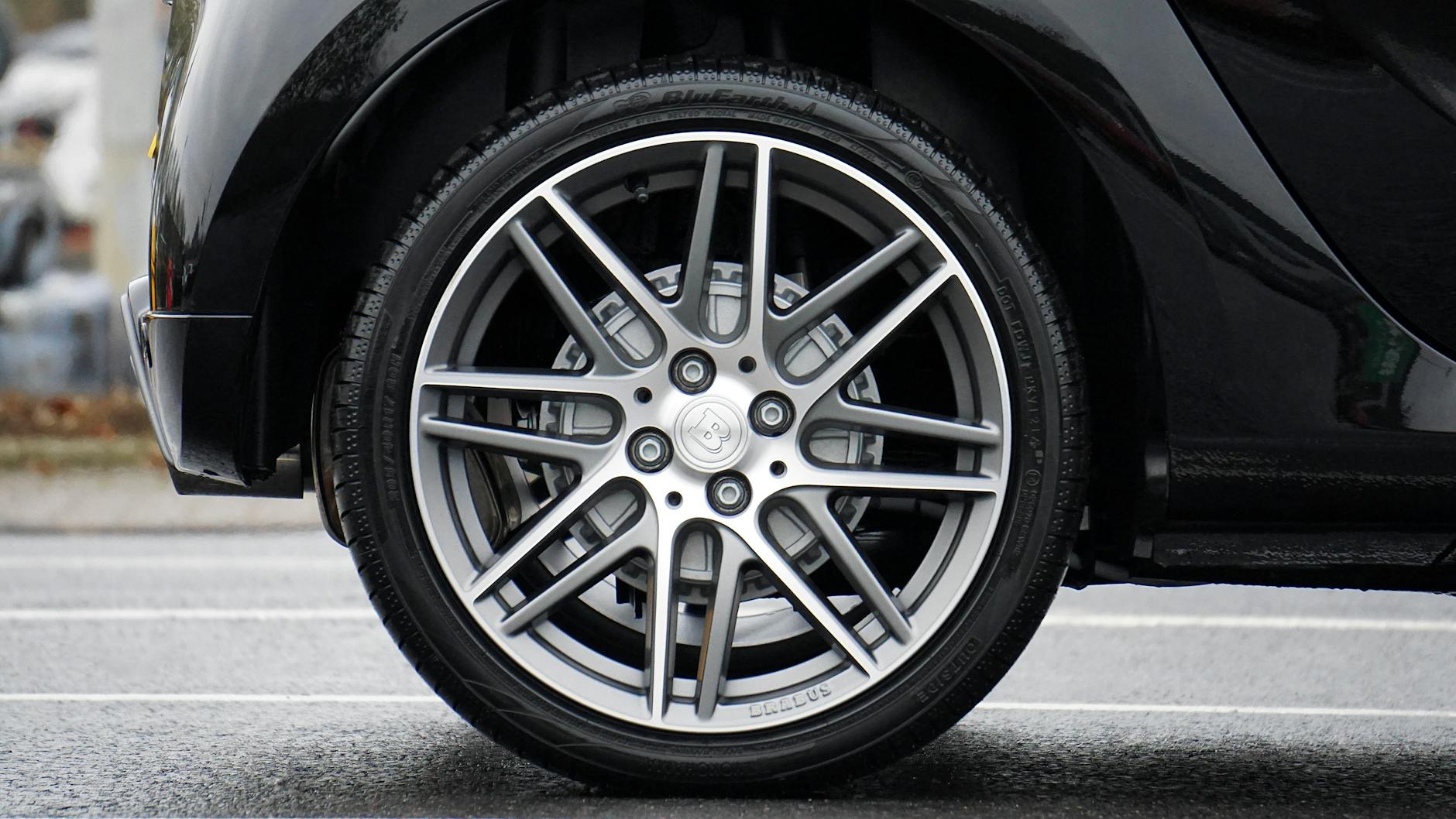
What Are Staggered Wheels? The Complete Guide

Staggered wheels are one of those setups that looks immediately right on certain cars — wide hips, meaty rear tires, a stance that communicates rear-wheel-drive intent without any modification badges required. But the term gets thrown around loosely, and a lot of buyers don't fully understand what they're committing to before they order. The fitment implications, the tire rotation question, the offset math — it all matters. This is the complete breakdown.
What Are Staggered Wheels, Exactly?
A staggered wheel setup means the rear wheels (and usually tires) are wider than the fronts. That's the core definition. On a car running a staggered fitment, you might have 18x8.5 wheels up front wrapped in 245/40 tires, and 18x10 wheels in the rear with 275/35s. The diameter is often the same; the width is what changes.
Sometimes the diameter staggers too — 19-inch front, 20-inch rear is a real configuration — but width stagger is far more common and more consequential to how the car drives and how you maintain it.
The width difference is usually between one and two inches of wheel width, which translates to roughly 20–30mm of additional tire width out back. On an F30 335i, for instance, BMW's own staggered spec is 225/40R18 front and 255/35R18 rear on the sport suspension cars. The factory knew what it was doing: more rear contact patch for traction under hard acceleration, matched to a lighter, narrower front that steers crisply.
Why Do Staggered Fitments Exist?
The engineering rationale starts with rear-wheel-drive physics. When power goes through the rear axle only, those tires are doing three jobs simultaneously: accelerating, braking (partially), and cornering. Front tires only handle steering and braking. Giving the rears more rubber makes sense — more contact patch means better traction under power, more stability at the limit, and better resistance to snap oversteer on exit.
Formula 1 cars used massively staggered tire setups for decades before aerodynamics and regulations changed things. Road-going rear-wheel-drive sports cars followed the same logic. The Porsche 911 has run staggered fitments since the air-cooled era — a 205 front, 225 or 245 rear setup depending on the generation. The C7 Corvette Stingray came factory staggered at 245/35ZR19 front and 285/30ZR19 rear. The Dodge Challenger Hellcat? 275/40R20 front, 305/35R20 rear.
These aren't styling choices. They're calibrated around the chassis dynamics of a car that sends 400–700+ hp rearward.
It's worth understanding why the relationship between power output and rear tire width matters so concretely. A tire's grip limit scales roughly with its contact patch area, which in turn scales with width and the load pressing down on it. When you add 30mm of rear tire width — going from a 255 to a 285, for instance — you're adding meaningful contact patch length under hard acceleration. On a 500 hp rear-wheel-drive car, that difference is felt immediately: wheel spin is harder to provoke, the car squats and launches rather than spinning and hunting for traction, and the transition from acceleration to mid-corner is more settled. On a 150 hp economy car, the same width change would go almost unnoticed. The stagger concept scales with the power it's designed to manage.
Which Cars Actually Benefit from Staggered Wheels?
The short answer: rear-wheel-drive cars with meaningful power. The longer answer involves understanding how your specific chassis is tuned.
RWD performance cars are the natural home. An S550 Mustang GT, a G80 M3, a 718 Boxster S, a GR86 — these platforms either come staggered from the factory or have well-documented staggered aftermarket specs that improve on OEM fitment. Running a 255 front and 285 rear on a Mustang GT makes sense both aesthetically and functionally. The rear end hooks up better, the car rotates more predictably, and the front doesn't get bogged down with excess tire that the suspension geometry can't fully exploit.
AWD performance cars are a more nuanced case. An Evo X, an RS3, a Model 3 Performance (which is AWD but rear-biased) — these can run staggered setups, but you need to be more careful. If your AWD system is sensitive to tire diameter mismatch between axles, even a small difference in rolling circumference from front to rear can confuse the center differential or torque vectoring system. On the Model 3 Performance, Tesla's factory spec is actually staggered: 235/35R20 front, 265/35R20 rear. They designed for it. But on a Subaru STI, swapping to a staggered setup without understanding the DCCD implications is asking for drivetrain stress.
The key on AWD cars is rolling circumference, not just width. Two tires can be different widths but have the same rolling circumference if their aspect ratios are calculated correctly — a 235/40 and a 265/35 on the same diameter wheel roll within a few millimeters of each other per revolution. When manufacturers like Tesla or BMW M (on the xDrive M cars) spec staggered AWD fitments, they choose sizes that are rolling-circumference-matched. Replicating that discipline on an aftermarket setup requires checking the actual rolling diameter numbers, not just eyeballing width differences.
FWD cars almost never benefit from staggered wheels, and attempting it creates problems. The driven wheels are upfront — you want traction there, not at the rear. A staggered FWD setup usually means a narrower front tire doing more work with less rubber, which is backwards.
The Trade-offs You Need to Understand
Tire Rotation Is Gone
This is the biggest practical trade-off and it catches people off guard. With a square setup (same width front and rear), you can rotate tires front-to-back on a regular schedule, evening out wear across all four corners. With a staggered setup, you can't — a 275 rear tire physically won't fit on a front fitment specced for 245s, and even if the width were close, the offset and backspacing are usually different between front and rear wheels.
The result: your rear tires wear faster than fronts, especially on a car that drives through the rear axle hard. On a high-power RWD car, rear tires might last 15,000–20,000 miles versus 30,000+ on the fronts. Budget for it. Some owners buy rear tires two at a time while still on their first set of fronts.
Directional tires compound this further. Many performance tires — Michelin Pilot Sport 4S, Continental ExtremeContact Sport, Bridgestone Potenza Sport — come in directional tread patterns designed to rotate in one specific direction. Directional tires can't be crossed side-to-side even on a square setup without dismounting and remounting, which adds cost and removes any remaining rotation flexibility. On a staggered setup with directional tires, you're fully committed to replacing fronts as a pair and rears as a pair on their own independent schedules. Know this before you choose your tire model.
Spare Tire Situation
A full-size spare becomes complicated. You'd need either a front-spec or rear-spec spare, and neither works for both ends. Most staggered-setup owners rely on run-flat tires (common on BMWs and Porsche) or carry a can of fix-a-flat and a portable compressor for emergencies. It's a real consideration if you do long highway trips or track days away from home.
Run-flats solve the spare problem but introduce their own trade-offs: stiffer sidewalls, harsher ride quality, and replacement-only repairability (most tire shops won't plug or patch a run-flat even for a minor puncture). Many enthusiasts on staggered setups who want a more compliant ride switch away from run-flats, accept the spare limitation, and rely on roadside assistance or a quality portable inflator for peace of mind.
Offset and Backspacing Must Be Dialed Per Axle
This is where custom wheel orders get interesting. Your front and rear wheels aren't just different widths — they likely need different offsets to sit correctly in the wheel arch. A wider rear wheel on most platforms needs a more negative offset (pushes the wheel face outward) to clear the inner fender and sit flush. Get this wrong and you either have rubbing under compression or a wheel that sits tucked too far inside the arch and looks wrong.
For example, on an F8x M3/M4, a common staggered aftermarket fitment is 9x19 ET35 front with 10.5x19 ET22 rear. Those offset numbers aren't arbitrary — they're calculated to match the hub-to-fender distance at each corner. The rear wheel is 1.5 inches wider and has 13mm less offset to compensate. Understanding this relationship is covered in detail in our guide to custom offset wheels.
One useful mental model: as wheel width increases, you generally need to reduce offset by roughly half the width increase to keep the centerline of the wheel in the same position relative to the hub. Going from a 9-inch wheel at ET35 to a 10.5-inch wheel, you're adding 38mm of width, so you'd subtract roughly 19mm of offset — landing near ET16. In practice, you also need to verify inner clearance against the strut, control arm, and brake caliper, so the final number gets confirmed against your specific suspension geometry. But that half-width rule gives you a sensible starting point.
Handling Character Changes
More rear grip doesn't automatically mean the car handles better for every driver. On a track day, a staggered setup biases the car toward understeer — the rear hooks up so well that it takes deliberate throttle and weight transfer to get rotation. Some drivers love this predictability. Others, especially those who enjoy sliding the rear, find a square setup more playful. Know your driving style before committing.
The handling balance shift is also sensitive to how much stagger you run. A mild stagger — say, 245 front and 265 rear — barely changes the handling feel compared to square. A more aggressive stagger — 245 front and 305 rear — produces a noticeably push-heavy car in slow corners. Track drivers who run aggressive stagger often compensate with a rear sway bar reduction or a front spring rate increase to rebalance the handling, effectively using suspension tuning to dial back the understeer introduced by the tire width bias.
How to Spec a Staggered Fitment Correctly
Start with your car's factory stagger, if it has one. That's the baseline the chassis engineers used. From there, you're either matching it or stretching it.
Most aftermarket staggered fitments add roughly 10–20mm of width at the rear compared to factory. On a car like the S550 Mustang that comes 235 front/255 rear from the factory, a common upgrade is 255 front/285 rear — keeping the relative width difference proportional while adding overall grip.
The things you need to confirm for each axle:
- Wheel diameter (often the same front to rear, sometimes +1" at the rear)
- Wheel width (rear is wider — how much depends on your fender clearance and desired look)
- Offset (must be calculated per wheel to achieve the right lip depth and avoid rubbing)
- Center bore (must match hub diameter exactly, or use hub rings)
- Bolt pattern (same for all four on any given car)
If you're ordering custom forged wheels, the offset can be tuned to the millimeter. That's a significant advantage over off-the-shelf fitments — you're not forcing your car to fit a wheel, you're building the wheel around your car. Our piece on custom forged wheels walks through the manufacturing side of that process.
Staggered vs. Square: Which Setup Should You Run?
For a high-power RWD sports car used for spirited road driving, staggered is usually the right call. It's how the car was designed to perform, the aesthetics match the chassis proportions, and the rear traction improvement is real.
For a track-only or autocross car, square setups are often preferred because they allow rotation (tire wear management matters at the track), and the handling balance can be dialed through alignment and spring rates rather than tire width. Autocross in particular rewards the ability to swap a fresh set of fronts in the paddock between runs — something that requires a square fitment or at minimum a matching wheel diameter front to rear so spare tires can be moved freely.
For a daily driver that also sees occasional canyon runs — either works. The staggered setup looks better on most RWD coupes and sedans. The square setup is cheaper to maintain over time.
For a car with any kind of aero package or custom bodywork, fitment becomes even more specific. Deep concave wheels in a staggered configuration need to be spec'd with inner-lip clearance in mind — the rear wheel, being wider with a lower offset, will have significantly more inner barrel depth. That's explored further in our guide to concave wheels.
What Staggered Wheels Look Like on Common Platforms
Visualize these numbers and they start making intuitive sense:
- BMW F30 335i — Factory sport: 225/40R18 front, 255/35R18 rear. Common aftermarket upgrade: 8.5x19 ET35 front with 265/35, 10x19 ET22 rear with 285/30.
- Mustang GT S550 — Factory: 235/50R18 all around (base), or 255/40R19 front, 275/40R19 rear on Performance Pack. Aftermarket stretch: 9.5x19 front, 11x19 rear.
- Porsche 911 (992) — Factory: 245/35ZR20 front, 305/30ZR21 rear. Massive stagger, massive performance intent. The 992 Turbo S widens further still — 255/35ZR20 front, 315/30ZR21 rear — reflecting how much power the all-wheel-drive chassis needs to put down.
- Tesla Model 3 Performance — Factory: 235/35R20 front, 265/35R20 rear. One of the few EVs specced staggered from the factory, which tells you how seriously Tesla's chassis team takes rear-axle traction. The instantaneous torque delivery of an electric motor makes rear contact patch area even more important than on a combustion car with a gradual power curve.
- Chevrolet Corvette C8 — Factory: 245/35ZR19 front, 305/30ZR20 rear, with different diameter on each axle. Mid-engine, so the weight distribution pushes toward a large rear tire.
- BMW M2 (G87) — Factory: 275/35R19 front, 285/30R20 rear. An unusual setup that staggers both width and diameter, reflecting how much torque the S58 engine delivers through the rear axle and how little the M engineers wanted to compromise front steering feel to accommodate it.
These numbers illustrate that stagger isn't a trend — it's a calculated fitment strategy used by every major performance car manufacturer on the planet.
Getting Custom Staggered Wheels Made
Ordering a staggered set of custom wheels means you're effectively ordering two different wheels, not one wheel in two quantities. The rear wheel is a distinct part — different width, different offset, sometimes different spoke geometry to accommodate the additional inner barrel depth.
For a forged or flow-formed set, this is standard practice. The tooling path adjusts per wheel spec, the CAD model accounts for each corner's requirements, and you end up with four wheels that are genuinely optimized for your car rather than adapted from someone else's fitment. The cost difference between a square set and a staggered set is usually modest — you're paying for four wheels either way; the rear pair just have slightly more material due to their wider profile.
One detail worth specifying clearly when you order: whether you want the spoke design to remain visually consistent between front and rear despite the width difference. On a deep-dish or high-concavity design, the rear wheel's increased inner barrel depth will naturally create a different-looking face angle than the front. Some builders match the lip depth proportionally so the visual concavity looks the same from the outside; others keep the outer face geometry identical and let the inner barrel absorb the additional width. Which approach suits your build is partly aesthetic preference and partly structural — a wheel optimized for a flush fitment at each corner will look more intentional than one where the rear sticks out slightly further than the front.
When submitting your build for a quote, have your axle measurements ready: track width front and rear, current tire and wheel specs, and any suspension modifications that affect clearance (coilovers, camber arms, fender rolls). The more precise your inputs, the more accurate the fitment outcome. If you're unsure where to start, the custom wheels and tires setup guide covers the measurement process in full.
Staggered wheels done right are one of those modifications that disappear into the car — they look like the car always came that way, because on the best platforms, it basically did.
Frequently asked questions
What does staggered wheels mean?
A staggered wheel setup means the rear wheels are wider than the front wheels. The rear tires are also wider as a result, giving the rear axle more contact patch for traction and stability on rear-wheel-drive vehicles.
Can you rotate tires on staggered wheels?
No — with a true staggered fitment, front and rear tires are different widths and the wheels have different offsets, so they can't be swapped axle to axle. This means rear tires wear faster and need to be replaced independently of fronts.
Do staggered wheels work on AWD cars?
Sometimes. If the manufacturer designed for it — like Tesla on the Model 3 Performance — it's fine. On AWD systems that are sensitive to tire diameter differences between axles (like Subaru's DCCD), a staggered setup can stress the drivetrain unless the rolling circumference is carefully matched.
How much wider are staggered rear wheels typically?
Usually 1 to 2 inches of wheel width difference, which translates to roughly 20–30mm of additional tire width at the rear. For example, a BMW M4 might run a 9-inch front wheel with a 10.5-inch rear.
Do staggered wheels change how a car handles?
Yes. More rear grip biases the car toward understeer in most conditions — the rear hooks up and resists breaking loose. This improves stability under hard acceleration but can reduce rotation in corners compared to a square setup with equal grip front and rear.
Can I run staggered wheels on a FWD car?
There's no functional reason to. Front-wheel-drive cars need traction at the front axle where the engine sends power. A staggered FWD setup would put a narrower tire on the driven wheels, which is counterproductive both for performance and safety.