Custom Wheel Builder: How to Get Exactly What You Want

Most people searching for a custom wheel builder are looking for something specific: a wheel that fits their car correctly, looks the way they want, and doesn't exist as a shelf product at any retailer. That's a reasonable thing to want. The problem is that the term gets used loosely — some brands call a finish selector a "builder," when really you're just picking between gloss black and matte bronze on a wheel that's already been cast in one size. This article explains what a genuine custom wheel builder process looks like, what decisions you actually have to make, and how to avoid wasting money on something that misses the mark.
What a Custom Wheel Builder Actually Does
A proper custom wheel builder starts with your vehicle's fitment requirements and your design preferences, then manufactures the wheel to those specs. That means the diameter, width, offset, and bolt pattern are not pulled from a bin — they're part of the build spec. This is different from buying an off-the-shelf wheel in a standard size and calling it custom because you chose the color.
The meaningful steps in the process are:
- Fitment spec — diameter, width, offset/ET, bolt pattern, center bore, and whether you're running staggered fitment (different front and rear sizes)
- Construction method — forged monoblock, flow-formed, or multi-piece
- Design selection or submission — choose from existing spoke designs, modify one, or upload your own
- Finish — machined face, brushed, powder coat, chrome, custom painted, or combinations
- 3D CAD review — see the actual wheel before metal is cut
- Manufacturing and delivery
If a builder you're looking at skips steps 1, 2, or 5, it's not really a custom wheel builder — it's a catalog retailer with a dropdown menu.
Fitment Is Where Most People Get It Wrong
Fitment is the most consequential decision in the entire process, and it's also where buyers most frequently make mistakes. Getting the design right and the fitment wrong means you've paid for a paperweight.
Offset is the most misunderstood spec. It's the distance in millimeters between the wheel's centerline and its mounting face. A wheel with ET25 sits further out than one with ET45 — that's what creates the deep, flush, or tucked look. On an F30 335i, the OEM front offset is around ET36 on a 225/40-18 setup. If you want a more aggressive stance, you might spec ET20 up front — but you need to verify clearance at the strut, the inner fender liner, and the caliper. A good custom wheel builder will ask about suspension modifications, brake upgrades, and any spacers you're running before signing off on offset.
Center bore matters more than people think. Factory hub bore on a 5x112 Audi is 66.6mm; on a 5x120 BMW it's 72.6mm. A wheel built with a 73.1mm bore needs a hub-centric ring to run on the Audi — fine if you know that, a vibration problem if you don't. Custom-built wheels can be machined to your exact hub bore so rings aren't needed.
Staggered fitment is standard on a lot of performance cars — the C7 Corvette runs 19x8.5 front and 20x10 rear from the factory, and many C8 builds push those sizes wider. Staggered wheels require two different wheel specs in the same order, which a real custom builder handles as a matched set.
For a complete breakdown of offset, bolt pattern, and center bore, the custom offset wheels guide covers the math in detail.
Construction: Forged vs Flow-Formed vs Cast
The construction method affects weight, strength, repairability, and price — in that order of importance for most buyers.
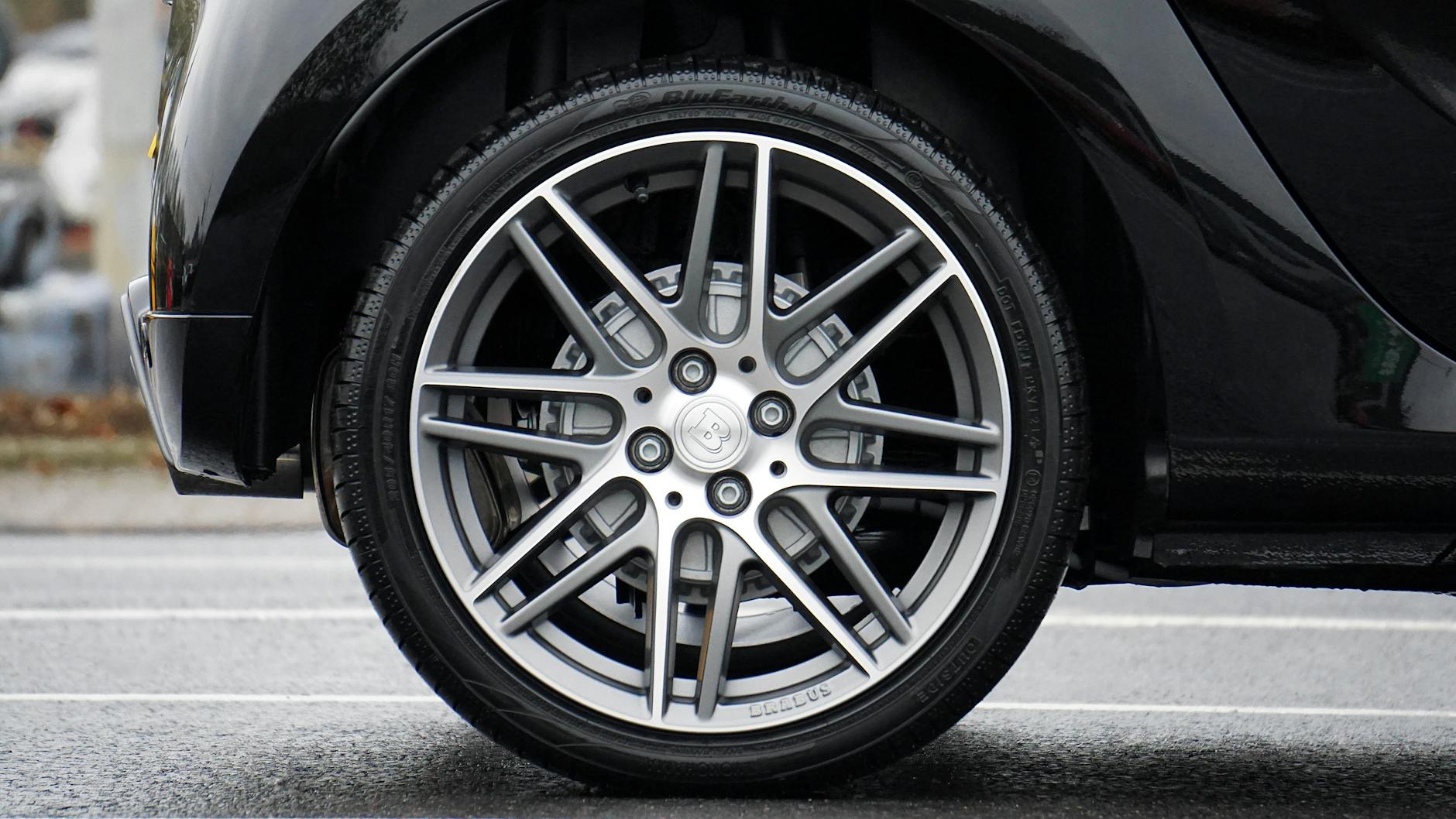
Forged monoblock is the gold standard. A billet aluminum blank is pressed under 5,000–10,000 tons of force, which aligns the grain structure of the alloy and produces a wheel that's significantly stronger per pound than cast. A forged 20-inch wheel for a Mustang GT can come in around 22–24 lbs depending on design; a comparable cast wheel often runs 27–30 lbs. That 5–8 lb per corner reduction is real unsprung weight savings, and it translates to steering feel and ride quality you can actually notice. The 1 piece forged wheels guide goes deep on this if you want the metallurgy.
Flow-formed (sometimes called rotary forged or flow forged) is a middle path. The center is cast, then the barrel is spun and rolled under pressure while hot, which work-hardens the alloy and reduces barrel weight. The result is a wheel that's lighter and stronger than a straight cast piece but cheaper to produce than a full forge. For daily drivers and street-focused builds, flow forged wheels offer excellent value.
Cast wheels are poured into molds. They work fine for many applications, but they're heavier for a given strength spec. On a track car or a high-power build, a cast wheel is a liability. On a Tesla Model 3 commuter build where weight savings matter for range efficiency, you want forged.
The cast vs forged wheels breakdown is worth reading if you're still deciding which construction path makes sense for your use case.
Design: Browsing, Modifying, or Going Fully Custom
A genuine custom wheel builder gives you three real options on design.
Browse existing designs. Most forging partners maintain a library of spoke profiles — Y-spokes, multi-spoke, mesh, split-spoke, turbine, monospoke. You pick one, spec your size and finish, and the factory machines it to your dimensions. This is the most common path and produces excellent results.
Modify an existing design. You like an 8-spoke design but want the spokes thinner, or you want a different spoke taper angle. Good builders will take that feedback through their CAD team and adjust the design before manufacturing. Not every builder offers this — it requires actual engineering capability, not just a catalog operation.
Upload your own design. If you have a specific vision — a spoke pattern you've sketched out, a design inspired by a vintage OEM wheel, or something genuinely original — a real custom wheel builder accepts your concept, redraws it as production-ready CAD with structural analysis, and builds it. This is the highest-involvement path, but it produces wheels that don't exist anywhere else.
Finish choice matters at this stage too. A machined face with a painted pocket is a classic combination — the spoke faces get a bright cut on a CNC lathe while the recesses go matte black or body-color. Brushed finishes show machining direction lines and age differently than polished. Powder coat is the most durable option for daily drivers. Custom chrome wheels are still popular on trucks and luxury builds, though they require more maintenance than powder or paint.
The 3D CAD Review Step — Don't Skip It
This step separates serious custom wheel builders from everyone else. Before a single piece of metal is touched, you should see a photorealistic render of your wheel — your exact spoke design, your finish, your size — mounted on a representation of your vehicle or at minimum shown from multiple angles.
Why does this matter? Because a spoke design that looks aggressive on paper can look thin and busy at 20 inches. A finish that looks great in isolation can disappear against a dark car. Offset decisions that seem right in a spreadsheet can look tucked or slammed when visualized. The render catches these issues before they become expensive mistakes.
Some builders offer a custom wheels visualizer tool that lets you preview designs on your actual car image before the order is even placed. That's a worthwhile feature to look for.
What the Ordering Process Actually Looks Like
At ForgedToFit, the process runs like this: you either browse our design catalog or upload your concept, tell us your vehicle and fitment requirements, and we generate a quote. Lead time on a full custom forged set is typically 6–8 weeks from design approval to shipping — this isn't a widget off a shelf, it's a wheel built to your spec from a forging blank. We work with a 15-year OEM forging partner, which means the same manufacturing infrastructure that supplies automakers is building your wheels.
Pricing lands 50–70% below legacy forged brands like HRE, Forgeline, or ADV.1 for equivalent construction. A set of four forged monoblock wheels in 20-inch fitment for a BMW M3 (5x112, ET20/ET25 staggered) from those brands typically runs $4,000–$8,000+. Custom-built forged wheels through ForgedToFit for the same spec run significantly less, with a 5-year warranty included.
If you're comparing against cast or flow-formed budget options, see the cheapest custom wheels breakdown — it's an honest look at where cutting cost makes sense and where it doesn't.
Platform-Specific Considerations
Different platforms have quirks that affect the custom build process.
BMW (F and G series): The combination of 5x112 bolt pattern, high positive offset requirements, and large brake packages (especially on M models) means offset selection is tight. A 20x9 ET25 front wheel on an F80 M3 with stock brakes will likely clear, but add a big brake kit and you're solving a clearance puzzle. The aftermarket BMW wheels guide covers platform-specific fitment in depth.
Mustang GT/GT500: The S550 and S650 platforms use 5x114.3, and the GT500 runs a factory staggered setup with 20x11 rear wheels. If you're running a Shelby or a tuned Coyote, wheel width at the rear matters for tire selection. 305/30-20 in the rear is a common setup, and you need the right offset to keep things flush without rubbing the quarter panel.
Tesla Model 3 and Model Y: Weight is everything here. Every pound of unsprung mass on an EV affects range and ride quality. A forged 20-inch set for a Model 3 Performance can save 12–18 lbs over the OEM 20-inch aero wheels — meaningful on a daily driver. The Tesla Model 3 aftermarket wheels guide has the OEM fitment specs and recommended sizes.
Trucks (F-250, Tacoma, RAM): Trucks have unique challenges — high load ratings, often lifted suspension, and aggressive tire fitment. A custom wheel builder for truck applications needs to understand load index requirements, backspacing vs. offset (the truck world still talks in backspacing), and how lift height affects how far a wheel can poke. The custom truck wheels guide is worth reading before you spec anything.
Corvette (C7/C8): GM's Corvette fitment specs are unlike anything else — the C8 runs a 5x120 bolt pattern with hub-centric fitment at 70.3mm. Factory sizes are already aggressive: 19x8.5 front and 20x11 rear on the Z51. Custom builders often push those to 20x10 front and 21x12 rear on track builds. The aftermarket Corvette wheels guide covers the full fitment landscape.
Verifying a Builder's Credentials
A lot of companies use the phrase "custom wheel builder" without having actual manufacturing capability. Here's what to ask:
- Do you manufacture, or are you a middleman reselling from a catalog? A real builder has a forging or manufacturing partner and can show certifications (JWL, VIA, TÜV are the relevant ones).
- Can I see the 3D CAD before you start manufacturing? If no, that's a red flag.
- What's the warranty? Legitimate manufacturers warrant against defects in material and workmanship — 3 to 5 years is standard for quality builders. No warranty or a 30-day return policy only means they don't stand behind the product.
- How do you handle fitment issues after delivery? The answer should involve a real process, not "check the return policy."
Also worth reviewing: how to buy forged wheels online covers verification steps in detail.
Price Reality Check
Forged custom wheels cost more than cast. That's a fact. But the gap between what legacy brands charge and what a direct-to-consumer builder can offer is genuinely large — not 10–15%, but 50–70%. The markup in the legacy forged wheel market exists because of brand positioning, dealer networks, and decades of captive audience pricing.
Flow-formed custom wheels are the budget-conscious entry point — you get real performance gains over cast without full forging cost. For a street car that isn't being tracked, flow formed vs forged wheels is worth reading before committing to a construction method.
For platform-specific recommendations on budget vs. premium, the best aftermarket wheels guide walks through the decision by use case.
Frequently asked questions
How long does it take to get wheels from a custom wheel builder?
For forged custom wheels, expect 6–8 weeks from design approval to delivery. Flow-formed custom builds are often faster, around 4–6 weeks. Any builder quoting faster than 3 weeks on a true custom forged set is either pulling from stock inventory or cutting corners on QC.
Can I use my own spoke design with a custom wheel builder?
Yes, if the builder has real CAD and manufacturing capability. You submit your concept — a sketch, a reference image, or a CAD file — and the builder's engineering team converts it to a production-ready design with structural analysis before manufacturing begins. Not every builder offers this; ask explicitly before assuming.
What information do I need to provide to get an accurate quote?
Year, make, and model of your vehicle; current wheel size and offset if known; any suspension modifications or brake upgrades; desired wheel size (diameter and width); whether you want staggered fitment; and your finish preference. The more specific you are upfront, the faster the quote process goes.
Is a custom-built forged wheel stronger than an OEM wheel?
Often yes, depending on the OEM. Custom forged monoblock wheels use the same 6061-T6 or 6082-T6 aluminum alloy and forging process as premium OEM suppliers, sometimes better. The key is that custom builders can optimize wall thickness and spoke geometry for your specific size rather than designing to a cost target like volume OEM production does.
Do custom wheels come with a warranty?
Reputable custom wheel builders include structural warranties — typically 3–5 years against manufacturing defects. At ForgedToFit, all wheels carry a 5-year warranty. Finish warranties are usually shorter (1–2 years) because finish wear depends heavily on maintenance and environment.
What's the difference between a custom wheel builder and just ordering custom-colored wheels from a retailer?
A retailer selling custom colors is selecting a finish option on a wheel that already exists in fixed sizes. A real custom wheel builder manufactures the wheel to your specified diameter, width, offset, bolt pattern, and center bore — the size and fitment are part of the build, not chosen from a dropdown. That distinction matters enormously if your fitment requirements don't match standard catalog sizes.